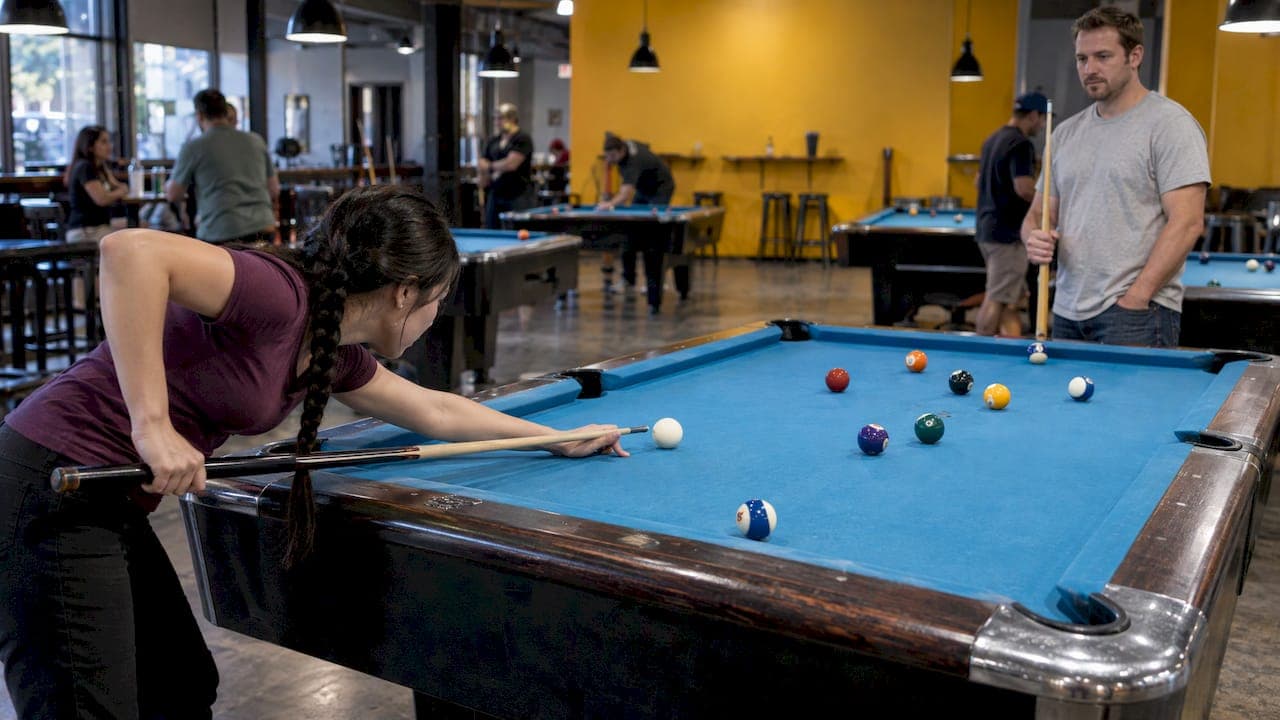
Chinese pool, usually called Chinese 8-ball or Heyball, is an 8-ball game played on a 9-foot snooker-style table with tight, rounded pockets and standard 2¼-inch pool balls. You pot your own group (solids or stripes), then pot the 8-ball to win. The rules will feel familiar if you play American pool. The table is what changes the game. The US Chinese Eight Ball Association describes it as combining the familiar rules of American 8-ball with the precision and difficulty of snooker.
This guide covers what the game is, how to rack, the rules that decide a rack, how it differs from American pool, and how to practice. It also covers where to play cue sports in Houston.
TL;DR
- Chinese 8-ball uses 15 numbered balls and a cue ball. You clear your group, solids or stripes, then legally pot the 8-ball.
- The table is 9 feet, with snooker-style napped cloth and tight pockets. Shots are not called, and a fluke counts.
- A foul gives your opponent ball in hand anywhere on the table. Competitive play uses a shot clock, usually 45 seconds per shot.
- Compared with American pool, expect longer shots, less forgiveness on pocket entry and more focus on cue-ball control.
- We offer Chinese 9-ball, American pool and snooker by the hour in Houston, with tournaments each week.
Table of Contents
- What Chinese pool is
- How to rack Chinese 8-ball
- The rules that decide a rack
- Chinese pool vs. American pool
- The table and cloth
- How to get better at Chinese 8-ball
- Chinese pool in tournaments
- Perspective: why cue-sport variety matters
- Play cue sports at Q Billiards Arena in Houston
- Related games worth knowing
- FAQ
- Sources
What Chinese pool is
Chinese pool is a cue sport that emerged in China in the 1980s. By 2017, Xinhua reported more than 60 million fans in China, and a world championship recognized by the major pool and snooker bodies. The same report describes an aggressive, fast-paced style that has drawn snooker legends and pool masters, partly because of the prize money.
The name causes confusion, because "Chinese pool" can mean more than one thing. Most people searching for it mean Chinese 8-ball, also called Heyball, the game covered here. Chinese 9-ball is a separate game with its own scoring, and we cover it in a different guide (see below).
The appeal is simple. The balls and the basic goal are the same as in the 8-ball you learned in a bar. But the table asks more of you, so a clean run-out feels earned.
How to rack Chinese 8-ball
Racking is where a lot of casual games go wrong, and the rules are specific. Per the World Chinese 8-Ball Masters rules, the object balls go in a triangle, racked as tightly as possible. The setup works like this:
- Put the apex ball on the foot spot.
- Put the 8-ball in the center of the triangle.
- Put one solid and one stripe on the two bottom corners.
- Place the remaining solids and stripes so they are separated as far as possible, while the rack stays tight.
- Before the break, both players can check that the balls are placed correctly and tightly, and either can ask the referee to adjust.
A tight rack matters because the break is the most important shot of the rack. The USCEBA training page lists a powerful, controlled break first among the skills to practice. If you want the official steps for the American version too, our guide to racking 8-ball for casual and league play walks through them.
The rules that decide a rack
Groups and winning
After the break, the first ball legally potted decides your group, solids or stripes. According to the USCEBA, you win by legally potting the 8-ball after clearing your group. The WPA Rules of Heyball state the same idea: pocket all of your own group first, then the 8-ball.
The table is always open after the break. Nobody is assigned a group on the break itself, which is a difference from some American league formats. The LeaguePool comparison notes that APA rules can assign groups on the break, while WPA rules leave the table open, as Heyball does.
Fouls
The USCEBA rules list these fouls:
- The cue ball fails to hit a legal object ball.
- The cue ball is pocketed.
- You strike the wrong group, or the 8-ball too early.
- The cue ball first contacts the wrong ball.
The penalty is ball in hand anywhere on the table. That is a heavy penalty on a big table, because your opponent can place the cue ball for the easiest run.
An illegal win happens when the 8-ball is potted before your group is cleared, or on a foul. In that case you lose the rack.
The break
Competition rules put a minimum on the break. At the World Chinese 8-Ball Masters, male players must meet a four-crossing minimum, with specified pocketing alternatives. Female players and players under 14 must meet a three-crossing minimum. A soft break that drives fewer than four object balls to the rails loses the rack. We break down this rule in our Chinese 8-ball rules and tournament tips.
Potting the 8-ball on a clean break is neither a win nor a loss, according to the LeaguePool guide. The breaker spots it and plays on, or breaks again. A foul on the break gives the opponent a choice between ball in hand behind the head string and a re-rack.
Shot clock and conduct
Competitive play is timed. Typically players get 45 seconds per shot and one extension per rack, usually 30 seconds. A reminder comes with 10 seconds left, and a countdown starts at 5 seconds.
A few more details from the LeaguePool guide: jump shots are legal when the tip strikes the upper half of the cue ball. Shooting one-handed, using an external extension or a bridge on the table, and having your phone ring are all fouls. It is a foul the first time and loss of the rack after that.
As an aside on equipment, the WPA rules say that from 25 August 2025 its UNITY ball set must be used in WPA-sanctioned Heyball events. That affects tournament organizers, not casual players.
Chinese pool vs. American pool
The games share balls and the basic aim. The differences are in the table and in a few rules. This table pulls the main ones together, drawing on the LeaguePool comparison and the sources above.
| Chinese 8-ball (Heyball) | American 8-ball (WPA) | |
|---|---|---|
| Table | 9 ft, snooker-style | Smaller; standard pool table |
| Cloth | Napped snooker-style cloth | Standard pool cloth |
| Cushions and pockets | Flat-faced cushions, rounded pockets | Pool-profile cushions, angled facings |
| Balls | 2¼ in | 2¼ in |
| Calling shots | Not called; flukes count | Called, except obvious shots |
| After the break | Table open | Table open under WPA rules |
| Shot clock | Usually 45 seconds, one 30-second extension per rack | Varies by event |
| Foul penalty | Ball in hand anywhere | Ball in hand |
The practical effect: in American pool a mishit often still drops, because the pockets are wide and the angled facings feed the ball in. In Chinese pool, an off-center hit rattles out. Position play becomes the heart of the game, because you need to leave yourself an angle that a tight pocket will accept.
Both games reward a good break, but the lack of called shots in Chinese 8-ball speeds things up. You do not announce a pocket, and a ball that falls by luck still counts. Many players find that this makes rack-to-rack play quick and aggressive.
The table and cloth
A Chinese 8-ball table has a playing surface of about 254 × 127 cm, which is larger than a typical American pool table. The competitive rules specify an internal playing area of 2,540 × 1,260 mm (plus or minus 9 mm), with the cushion top 800 to 850 mm off the floor.
Pockets are the other big factor. Corner pockets are typically about 8.3 cm (3.25 in) wide and middle pockets about 9.5 cm (3.75 in), per the same dimensions page. The jaws are often cut straight or with a minimal angle, as on a snooker table.
Why does that matter for you at the table?
- Long shots are normal. Plan on cue-ball travel across a lot of cloth, so speed control gets tested every shot.
- Pocket speed matters. A ball that arrives too fast can rattle in the jaws. Smooth, medium pace tends to be the safer play.
- Cloth changes the roll. Napped cloth plays differently from smooth pool cloth, and the nap affects how the cue ball runs and turns.
The ball size is the same as in American pool, 2¼ inches. The rules specify a diameter of 57.15 mm (plus or minus 0.05 mm) and a weight of 156 to 170 g. The Heyball cue must be at least 101.6 cm long and meet the standards of the International Chinese 8-Ball Association.
How to get better at Chinese 8-ball
The USCEBA names five areas to practice: a powerful, controlled break; aiming and cue-ball control; position play through spin and speed; safety shots when no clear pot exists; and calm, concentrated decisions under pressure. Here is how to turn those into a routine.
Start with the break
Practice breaking until you consistently drive four or more object balls to the rails, since the break rule punishes a soft break in competition. Aim for control over raw power. A break that scatters the rack but leaves the cue ball near the center gives you the best first look at the table.
Plan the whole rack
Before your first shot, look at the open table and pick a group by which one has the easier path. Then think backward from the 8-ball: where do you want the cue ball when only the 8 is left? Our 8-ball strategy guide goes through that approach, and it transfers directly to the bigger table.
Drill speed and position
- Shoot a straight-in shot and stop the cue ball dead, then follow it one foot, then two.
- Pot a ball along the long rail and try to land the cue ball within a cue-length of a marked spot.
- Play a rack with a self-imposed 45-second clock so the real one is not a surprise.
Learn when to play safe
If you have no clear pot, a safety is often better than a risky shot. With ball in hand as the penalty for any foul, giving your opponent a free table is costly.
Chinese pool in tournaments
The sport has a growing competitive scene. The WPA World Heyball Championship has been held since 2015, per a list of world eight-ball champions. In the US, the 2024 Americas HeyBall Championships in Quincy, Illinois, introduced Heyball to the Americas. It was organized by the Billiard Congress of America and the Greater Midwest PoolPlayers Association and sanctioned by the WPA. It used 16 nine-foot tables, a $100 entry fee, and 64 players in each of the men's and women's fields, with $58,000 in prize money per division.

Match formats vary. The Home Leisure Direct guide says that modern tournaments can be timed formats: first to 13 frames, or most frames within an allocated time limit such as 140 minutes. Always check the format and rules sheet for the specific event.
Perspective: why cue-sport variety matters
We run a 25-table club in Houston, and our view is simple: players get better when they can try more than one game. Chinese pool is a good example. It trains the same fundamentals that every cue sport rests on: a controlled break, clean cue-ball speed and patient position play.
That is why we built our floor around variety. Alongside American pool we offer standard and heated snooker, Chinese 9-ball and carom billiards, and we run weekly tournaments for different cue sports. Someone who practices position play on a snooker table will see it in their pool game the next week.
We also believe a pool hall should be somewhere you want to stay. Late hours, fresh food and drinks, and a room full of people who love the game make a long practice session feel like a night out.
Q
Play cue sports at Q Billiards Arena in Houston
We are a Houston billiards club with 25 professional-grade tables across 11,000 square feet, open late. You can rent tables by the hour: American pool is $10 per hour, standard snooker is $15 per hour, heated snooker is $20 per hour, and Chinese 9-ball and carom billiards are $15 per hour each. See the full list of games and rates.
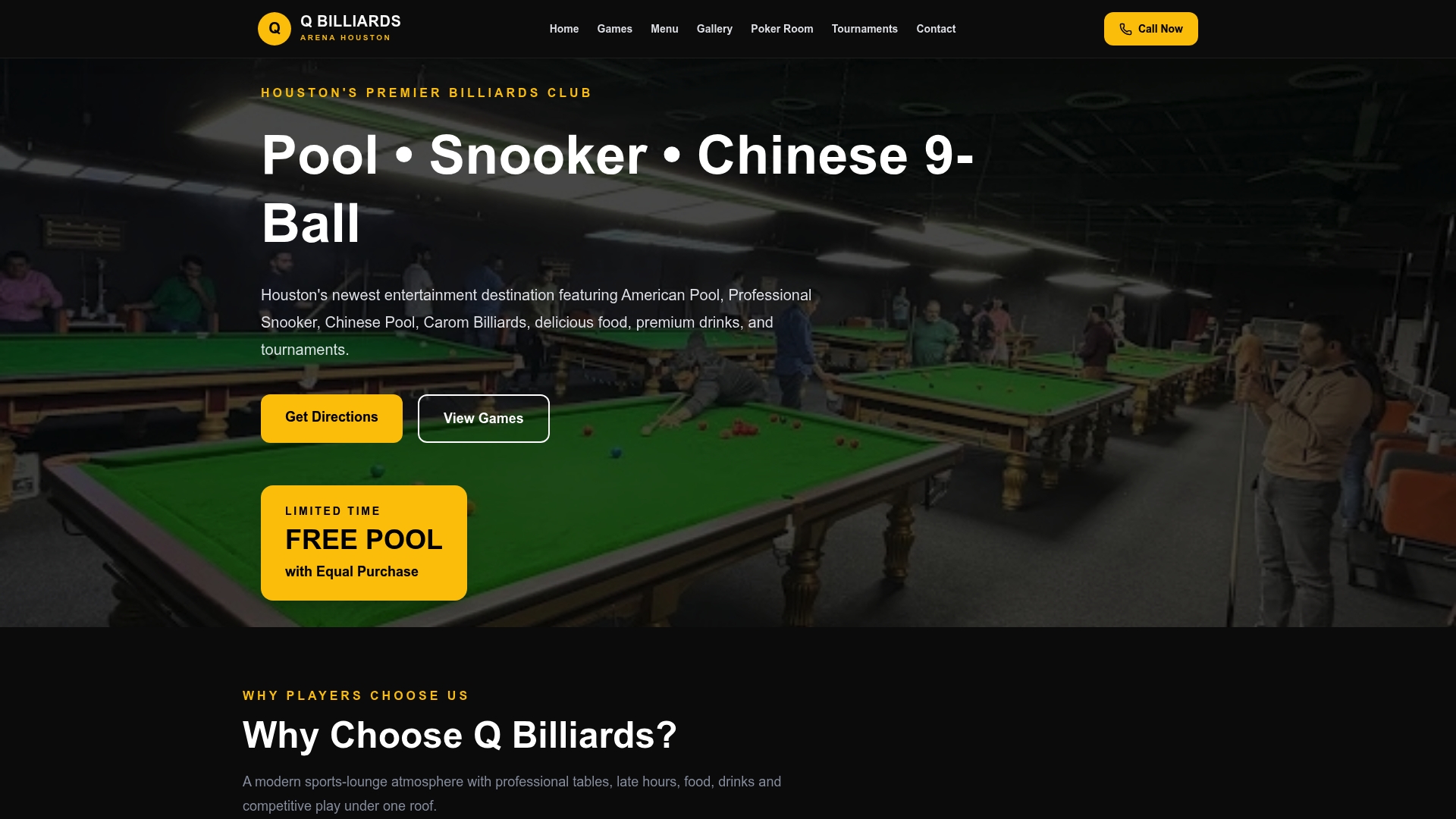
If you want to try the Chinese-style game we offer, our Chinese 9-ball page has the details. For competition, the Tuesday Night and Friday Night Pool Tournaments each cost $10 to enter, and the 1-Red Snooker Tournament is $20. Snacks, food and drinks are available while you play on our menu. For groups, ask about our poker room rental.
Related games worth knowing
Once you are comfortable with Chinese 8-ball, a few neighbors are worth learning. Chinese 9-ball scores differently and awards a point for each foul, which we cover in our Chinese 9-ball tournament rules. Standard 9-ball has its own break and push-out rules, covered in our 9-ball rules guide. Each one tests slightly different skills, and switching between them keeps practice fresh.
FAQ
What is Chinese pool?
Chinese pool usually means Chinese 8-ball, also called Heyball. It is played with 15 object balls and a cue ball on a 9-foot snooker-style table with tight pockets. You pot your group, solids or stripes, then the 8-ball. The sport emerged in China in the 1980s, according to Xinhua.
How is Chinese 8-ball different from American pool?
The table is bigger and the pockets are tighter, with napped cloth and flat-faced cushions. Shots are not called and flukes count. The table is open after the break, and competitive play uses a shot clock, usually 45 seconds per shot.
What happens when you foul in Chinese 8-ball?
Your opponent gets ball in hand anywhere on the table. Fouls include missing a legal object ball, pocketing the cue ball, and striking the wrong group or the 8-ball too early. A foul on the break gives the opponent a choice of ball in hand behind the head string or a re-rack.
Are the balls the same size as in American pool?
Yes. Both games use 2¼-inch balls. The difference is the table, its cloth, cushions and pockets, not the balls.
Sources
- US Chinese Eight Ball Association
- USCEBA Training and Rules
- Chinese pool enjoys increasing global clout, Xinhua
- WPA Rules of Heyball (2025)
- Rules of Chinese 8-ball, World Chinese 8-Ball Masters (2017)
- Chinese 8-Ball (Heyball): Rules, Table and Difficulty, LeaguePool
- Chinese 8 Ball Pool Table Dimensions, Tablesroom
- 2024 Americas HeyBall Championships athlete guide, BCA
- Complete Guide to Chinese 8-Ball, Home Leisure Direct
- List of world eight-ball champions