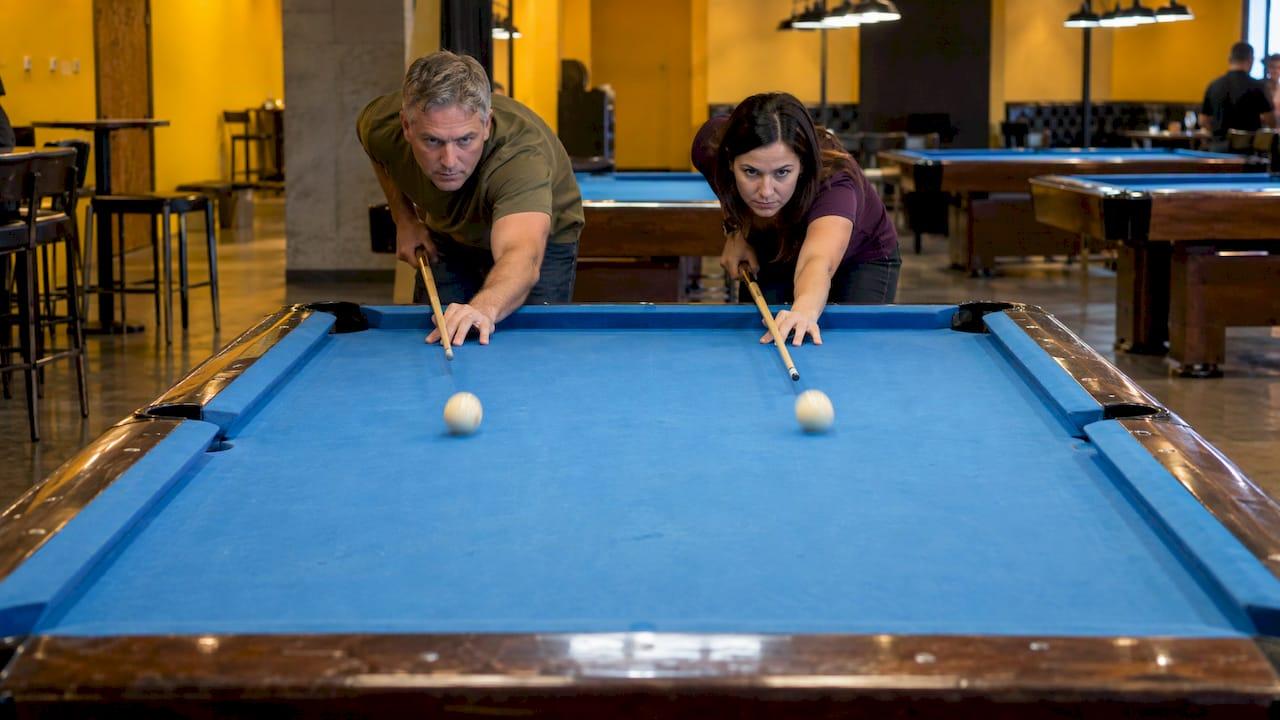
The lag is the first shot of a pool match, and it decides who breaks. Both players shoot a ball from behind the head string at the same moment, send it down to the foot rail and let it come back. The ball that stops closest to the head rail wins. Win it by controlling speed, not power: a smooth, level stroke with a center hit that lets the ball die just short of the rail. Below you get the steps, the rules that make a lag bad, the technique and a practice routine. If you want a table to practice on, we have 25 of them in Houston.
TL;DR
- Both players shoot at about the same time from behind the head string. The ball that stops closest to the head rail wins the lag and gets the choice of who breaks.
- Your ball must hit the foot rail and come back without touching a side rail or dropping in a pocket. Otherwise it loses.
- Speed control wins lags. Use a smooth stroke, a center hit and no spin, and keep accelerating through the ball.
- Rules differ by format. Leagues, pro rules and tour events handle the lag and the break after it in slightly different ways.
- Practice 10 lags a session and track how many stop in the last diamond before the head rail.
Table of Contents
- What the lag decides
- How to lag in pool, step by step
- The rules that make a lag bad
- When a lag is not used at all
- How to win the lag: speed, not power
- A lag practice routine you can use in one session
- Lag etiquette that keeps matches friendly
- Should you take the break?
- Practice the lag at Q Billiards Arena in Houston
- Our view: the lag is the cheapest advantage in pool
- FAQ
- Sources
What the lag decides
The WPA Rules of Play (the World Pool-Billiard Association, which sets the standard international rules) state that the lag is the first shot of the match and determines the order of play. The winner chooses who shoots first. In most cases the winner chooses to break.
That matters most in the games where the break is an advantage. In 9-ball, a clean break can lead straight to a run-out. The same WPA rules say that in disciplines scored by the rack, such as 9-ball, the break alternates between players. So the lag gives you the first break, and after that the format takes over.
In APA league play, which uses winner-breaks formats in many divisions, the picture is different. The lag winner breaks game one, and after that the winner of each rack breaks the next one. Winning that first lag can start a run of breaks. Check your league's format before the match so you know what the lag is worth.

How to lag in pool, step by step
Here is the standard shot, as it works in league and tournament play.
- Pick your ball. Use a ball of equal size and weight to your opponent's. Many leagues discourage using the cue ball. The APA rules discourage it and treat insisting on the cue ball as a sportsmanship violation.
- Set up behind the head string. The head string is the imaginary line across the table at the second diamond from the head rail, where the break shot is normally played from. Each ball sits on its own side of the table, behind that line.
- Count down and shoot together. The APA rule says players lag from behind the head string at approximately the same time. The WPA rules say the same: both players shoot at about the same time.
- Hit the foot rail. Your ball travels the length of the table, touches the foot rail and rolls back toward the head rail.
- Read the result. The ball that stops closest to the head rail wins. If you cannot tell which is closer, lag again.
- Declare your choice. The winner states clearly whether they will break or pass the break.
The common mistake is treating step 4 as a power shot. Hit too hard and the ball bounces off the head rail and drifts away. Hit too hard and also wide and it clips a side rail, which usually loses the lag outright.
The rules that make a lag bad
A lag is not just about distance. Each rulebook has a list of ways to lose it. Most are similar, with some differences you should know before you play in a league or event.
| Rule set | Loses the lag | Re-lag |
|---|---|---|
| WPA Rules of Play (effective 2025-09-15) | The ball crosses the long string, hits the foot cushion other than once, is pocketed or driven off the table, touches a side cushion, or rests in the corner pocket past the nose of the head cushion | A ball is struck after the other touched the foot cushion, the referee cannot tell which is closer, or both lags are bad |
| APA league rules (League Years 2026/27 to 2028/29) | Failing to strike the foot rail, striking a side rail, or pocketing the ball | The lagged balls touch each other, both players fail to strike the foot rail, or a ball stops in the jaw of a pocket |
| International Eightball Pool Federation | The ball crosses into the opponent's half, misses the foot cushion, drops in a pocket, jumps the table, touches the long cushion, rests in a corner pocket past the nose of the head cushion, or hits the foot cushion more than once | Not covered here |
| International Billiards Association | Everything above for pockets and side rails, plus contact with a foreign object such as a stick, a person or a rack | Not covered here |
Two details trip up casual players. First, in APA play striking the head rail is permissible. A ball that bounces off the head rail does not lose, as long as it stops closest to it. Second, the WPA rules ban touching the side cushion even once, so a ball that kisses the side rail near the head can lose a lag it would otherwise win.
If you play in more than one environment, assume the stricter version: foot rail once, no side rail, no pocket, and no touching the other ball.
When a lag is not used at all
Not every format lags for the break. Under UPA rules (US Professional Poolplayers Association) for 9-ball and 10-ball, the player with the lowest Speed rating breaks first, and the break alternates after that. The lag for break is used only when two players have equal Speeds. The winner is the player whose ball is closer to the head of the rail.
In APA Masters Divisions the winner of the lag has the choice of format or the break, according to the APA's April 2026 notes on the official team manual. That rule applies to League Years 2026/27 through 2028/29.
The practical point: before you walk to the table, ask your league captain or tournament desk how the first break is decided. Sometimes a lag is skipped, sometimes it is the whole decision.
How to win the lag: speed, not power
The lag looks easy and is one of the hardest shots in pool to repeat. You need to send a ball about 100 inches or so, down and back, and stop it within an inch or two of a rail. Here is what works.
Use the cushion on purpose
Dr. Dave Alciatore, a pool instructor and author of the Billiards Digest instructional series, explains in his speed-control principles that a cushion slows the cue ball by about half. That gives you twice the margin for error when you bounce a ball off a cushion than when you try to stop it just short of one. In a lag, the ball touches the foot rail on the way back, so the foot rail does some of the work for you. The head rail is where precision matters: you want the ball to die just short of it, not to rebound.
Keep the stroke smooth
The same Alciatore piece recommends varying stroke length in proportion to the speed you want, with the same smooth, unhurried acceleration every time. He also says to finish the stroke and accelerate through the ball instead of slowing down into it. A decelerating stroke is the classic lag mistake: it feels gentle, but it makes the speed inconsistent.
Keep the hit simple
- Hit the ball at its center, with no English (side spin). Spin changes how the ball behaves off the rails and adds a variable you do not need.
- Keep the cue level. A raised butt adds unwanted spin and can make the ball skid.
- Pick a spot on the foot rail straight ahead and aim at it. A ball that wanders toward a side rail loses the lag.
- Think about the speed for the whole trip, not only the first foot of travel.
Know your target
Darren Appleton, a champion who writes for Billiards Digest, argues that the lag matters in any alternate-break format. He notes that Team Europe won 11 of 14 lags at the 2020 Mosconi Cup, and he claims that consistently stopping the ball between the head rail and the first diamond wins at least 75 percent of lags. That gives you a clear target: do not aim for the rail, aim for the zone just in front of it.
Appleton also describes his routine when the match table is available for practice: he tries a few lags and hits the ball against all the rails to feel the speed. Tables differ in cloth speed and cushion response, so a few warm-up shots tell you more than any rule of thumb.
A lag practice routine you can use in one session
You do not need a coach for this. You need a table, two balls and about 15 minutes. For more cue-ball distance work, our guide to speed control drills for pool has seven more exercises.
- Warm up with five lags with no scoring. Watch how far the ball travels on a given stroke length.
- Shoot 10 lags in a row. Score 1 point for each ball that stops within one diamond of the head rail without touching a side rail. Score 3 points if it stops within a few inches of the rail.
- Write your total down. Repeat at the start of each session.
- Change one thing at a time: stroke length, tempo or grip pressure. If your score drops, go back to the last version that worked.
- Finish with five lags against a friend, shooting at the same time, so you get used to the pressure of a live lag.
The benefit goes past the lag. Speed control on a down-and-back shot carries over to your break, your safety play and your position play. If the break is the next thing you want to work on, our article on repeatable breaks in 8-ball is the logical next read.
Lag etiquette that keeps matches friendly
Most lag disputes are about timing and the ball. These habits avoid arguments, and they match the rulebooks.
- Shoot together. Both rulebooks say players lag at about the same time. Waiting to see where your opponent's ball stops before you shoot is poor form, and in a tournament a referee can order a re-lag.
- Stay on your side. Do not lean across the string or the table while your opponent shoots.
- Offer an object ball. If your opponent prefers not to use the cue ball, switch. The APA discourages the cue ball for exactly this reason.
- Ask the referee in a tournament. If you are unsure whether a ball touched a rail or which one is closer, ask before touching either ball.
- Re-lag cheerfully. If it is too close to call, do it again.
- Say what you are doing. The winner should say clearly and quickly whether they will break or pass.
If you play team formats, the lag can also be the hinge of a whole match. In our guide to Scotch Doubles rules for leagues, one lag decides the break, which makes it worth practicing as a pair.
Should you take the break?
Usually yes in 9-ball, because a good break gives you the first shot at a run-out. In 8-ball the answer depends on your break. If you are more consistent at spreading the rack than at running out, take it. If you are better in open-table positions, passing the break can work. Think about this before you lag, so you decide in seconds. If you are newer to the game, our beginner guide to playing pool covers the basics you need before you worry about strategy, and our 8-ball strategy article shows how to plan a rack once you have the table.
Practice the lag at Q Billiards Arena in Houston
Lag practice goes faster on a full-size table with an opponent. At Q Billiards Arena, American pool is $10 per hour, and Chinese 9-ball and carom billiards are $15 per hour. You can see all the table games and hourly rates before you come in. We have 25 professional-grade tables across 11,000 square feet, and our late hours run until 2 to 4 AM, so you can practice when the room is quiet. Our promotion of free pool with an equal purchase is there for groups who want food and drinks while they play, and the menu covers food, snacks and hot and cold drinks.

If you want to use the lag in a real match, our Tuesday and Friday night pool tournaments are $10 each to enter. For snooker players, the 1-Red Snooker Tournament is $20, and details are on the snooker page. For groups planning something larger, the poker room can be rented for events.
Our view: the lag is the cheapest advantage in pool
Most players spend hours on their break and none on the lag. We think that is backwards. A lag takes ten seconds, costs nothing and decides who gets the first shot.
We built Q Billiards Arena for people who want to play seriously and socially under one roof. That means 25 professional-grade tables, American pool, snooker, Chinese 9-ball and carom billiards, and weekly tournaments for different cue sports. A lag drill is one of the best uses of a table hour, because the speed you learn there shows up in everything else you shoot.
Our advice is simple. Come in before a league night or a tournament, shoot 10 lags on a full-size table, and warm up the way you will play. When you are comfortable with the lag, the break and the tournament nerves, you will feel the difference. We also stay open late, so the table is there when your schedule is.
Q
FAQ
What does "lag for break" mean?
It means both players shoot a ball down the table and back, and the one that stops closer to the head rail wins the right to decide who breaks. The WPA rules call it the first shot of the match, and it determines the order of play.
Can you use the cue ball to lag?
In casual games, yes, but many leagues discourage it. The APA rules say players are discouraged from using the cue ball, and insisting on it can be reported as a sportsmanship violation. Use an object ball of the same size and weight if your opponent asks.
Does the ball have to hit the head rail?
No. The ball must hit the foot rail and return, and the one that stops closest to the head rail wins. In APA play, striking the head rail is permissible, so a ball that touches it can still win.
What happens if the two balls end up at the same distance?
You lag again. Both the WPA rules and the APA rules call for a re-lag if the result is too close to call, and the APA also requires one if the balls touch each other.
Does the winner of the lag always break?
The winner chooses who shoots first, and most winners choose to break. In formats where the break alternates, such as 9-ball under WPA rules, the lag only decides the first break. In winner-breaks formats, the winner of each rack breaks the next one.
Sources
- WPA Rules of Play, effective 2025-09-15
- Lagging: Pool Rules for APA League Play
- APA: New Official Team Manual Notable Redlines
- UPA Official 9-Ball Rules
- International Eightball Pool Federation rules
- International Billiards Association Rulebook
- Dr. Dave Alciatore, Speed Control illustrated principles
- Billiards Digest, Perfect Practice with Darren Appleton