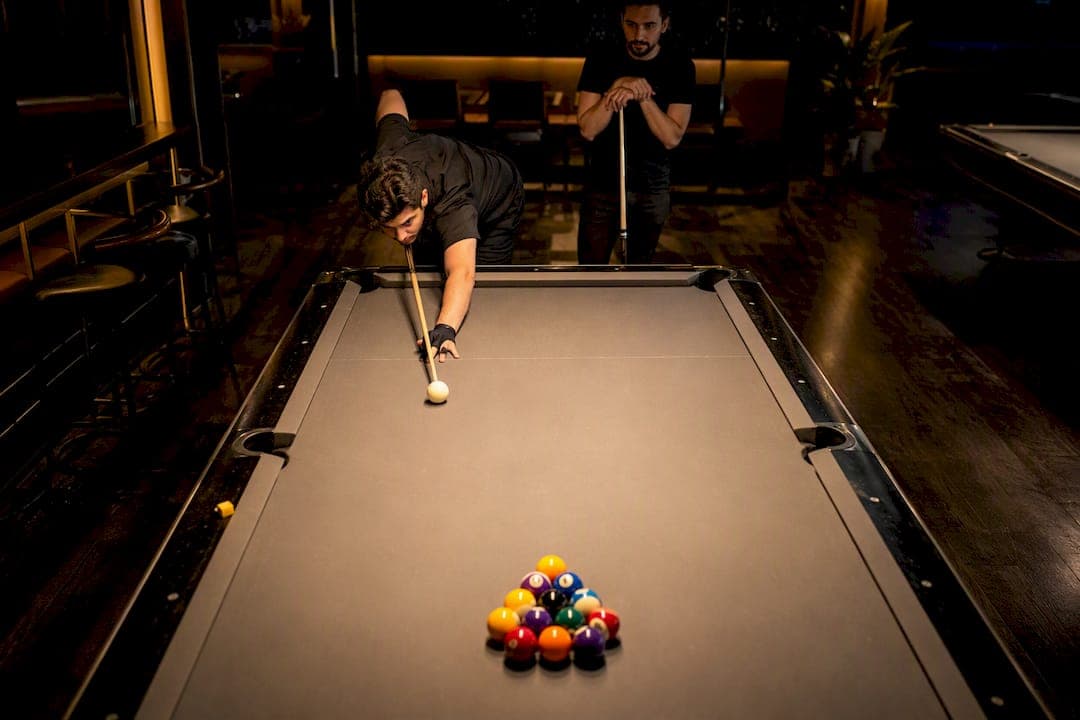
Scotch Doubles is a two-person team format in which partners alternate every shot on the same ball, meaning you shoot once, then your partner shoots, then you again, all the way through the frame. The rotation never pauses for a good position or a tricky angle. Break shots, fouls, and safeties can shift whose turn comes next, and leagues like VNEA and UPA each add their own wrinkles worth checking before match night.
TL;DR:
- Teams must decide roles before the match to ensure smooth coordination during alternate shots and reduce disagreements.
- Fouls like scratching or hitting out of turn result in ball-in-hand penalties or loss of turn, emphasizing careful shot execution.
- The game ends when a team legally pockets their group and then the 8-ball into a called pocket, with scratching on the 8-ball usually meaning loss of game.
- League rules can vary on lag mechanics, foul enforcement, and safety calls, so players should confirm specifics before starting.
- Good team habits include warming up together, keeping the shooting area clear, and using simple signals for safety calls to improve flow.
Table of Contents
- 1. Team setup, racking, and the break
- 2. Alternate-shot rotation and what counts as a legal shot
- 3. Common fouls and how penalties work
- 4. How a team wins the frame
- 5. What partners can say to each other mid-match
- 6. How league and house rules can differ
- 7. Tips from Q Billiards for smoother team play
- Why Scotch Doubles earns its spot on league night
- Play Scotch Doubles at Q Billiards Arena
- Where to check the official rules
- Sources
- FAQ
1. Team setup, racking, and the break
Every Scotch Doubles team fields two players who share one cue ball for the entire frame. A standard 8-ball rack holds all 15 object balls, with the 8-ball placed in the center of the triangle and the corners mixed between stripes and solids.

Before the first ball moves, one player from each team lags for the break. Most rule sets, including VNEA's Scotch Doubles rules, permit only one lag per match rather than a re-lag between frames, so the winner of that single lag typically earns the choice of break or table side for the set.
A legal break requires the cue ball to stay on the table and at least one object ball to either drop or reach a rail. Until someone legally pockets a called ball, the table stays open, meaning either team can shoot at stripes or solids.
- Two players per team, one shared cue ball for the whole frame.
- One lag decides the opening break, not a re-lag each game.
- The table remains open until a legal pocket sets the groups.
2. Alternate-shot rotation and what counts as a legal shot
Rotation is the backbone of the format, and it never bends for strategy. Once a player shoots, their teammate is up next regardless of position, difficulty, or who is more comfortable with the shot.
- Shooters alternate strictly: if you shoot this turn, your partner shoots the next one, and skipping the rotation is a foul even if the ball was pocketed legally.
- After the groups are set, a legal shot means the cue ball contacts your team's group first, then either a ball drops or any ball reaches a rail; on an open table, any ball may be struck first.
- A player can call a safety before shooting, telling the table they intend to play defense rather than pocket a ball; any object ball that drops on a declared safety stays down according to VNEA's rule excerpts, and the inning simply passes to the other team.
Declared safeties get used constantly in doubles play because they let a team hand over a messy layout without losing ground on the balls already pocketed.
3. Common fouls and how penalties work
Fouls in Scotch Doubles cover the usual suspects from standard 8-ball, plus rotation-specific mistakes that only show up in doubles play.
- Scratches: pocketing the cue ball hands the opposing team ball in hand, letting them place the cue ball anywhere on the table.
- Out-of-turn shots: shooting when it is your partner's turn is a foul even if you pocket a ball cleanly.
- Double hits and jump-offs: striking the cue ball twice or launching an object ball off the table both count as standard fouls.
- Touched balls: accidentally moving a ball with your body, clothing, or cue outside of a legal stroke is a foul, and the ball is typically spotted back if it was pocketed.
- 8-ball scratches: pocketing the cue ball on the same shot as the legal 8-ball is usually a loss of game, not just a foul.
Slow play gets policed too. Published league rulebooks commonly warn a player first, then start a one-minute clock on subsequent shots, with repeated violations risking loss of the game. Calling a foul is done before the next shot begins, never retroactively once play has continued. For more on how cue ball placement works after a foul, see this breakdown of cue ball fouls and in-hand placement.
4. How a team wins the frame
A team wins by legally pocketing every ball in its group, then legally pocketing a called 8-ball into a called pocket. Call-shot rules on the 8-ball vary somewhat by house and league, so confirm the local standard before the match starts.
Scratching on the 8-ball is typically loss of game rather than a simple foul, which is one of the sharpest differences from regular rack play. Some rule sets allow the opposing team to place the cue ball anywhere and continue if the 8-ball is pocketed on a foul that is not itself a scratch, so read your local sheet closely.
League scoring adds another layer on top of the win condition. Some leagues score by individual games won, while others tally match points across a full set, so the frame-by-frame result does not always map directly to standings. Our guide on playing backward from the eight breaks down shot planning once you are down to the last few balls.
5. What partners can say to each other mid-match
Communication rules exist because Scotch Doubles is a team sport played on an individual turn. Most leagues allow partners to talk between shots, often capping coaching conversation around 15 seconds so play does not stall.
Slow play penalties still apply during that window, and the same one-minute guideline used for shot timing tends to cover extended discussions too. Keep exchanges short: point out the shot, agree on a safety if needed, and step back.
Sportsmanship matters as much as the clock. Give feedback without frustration, let one partner approach the table at a time, and settle disagreements quietly rather than at the table where it slows the next team down.
Pro Tip: Agree on a one-word safety call, like "tuck," before the match starts so your partner instantly knows your intention without a lengthy explanation.
6. How league and house rules can differ
UPA's published guidelines focus heavily on the administrative side of doubles: roster and membership prerequisites, team speed limits, point splits, and how rotation gets maintained and enforced across a season, according to the UPA Scotch Double Guidelines. VNEA's Scotch Doubles rules lean more into the mechanics on the table, spelling out fouls, slow play, and rotation enforcement in more procedural detail.

House rules fill in whatever the league sheet leaves open, including lag mechanics, whether banks and combinations must be called, and substitution rules if a partner has to leave mid-session. Always confirm specifics with your league operator before the first rack.
7. Tips from Q Billiards for smoother team play
A few habits separate teams that flow through a rack from teams that argue their way through it.
- Decide roles before the match: one partner takes long straight shots, the other handles kicks and banks.
- Warm up with a two-minute break-and-recover drill, alternating shots to rebuild the rhythm of switching after every turn.
- Keep the area around the table clear on both sides so neither partner is boxed out when it's their turn to shoot.
Pairing these habits with dedicated safety practice, like the drills in our snooker safety play guide, sharpens the defensive half of doubles play too.
Why Scotch Doubles earns its spot on league night
Scotch Doubles rewards teamwork over raw skill, which is exactly what makes it work for mixed-ability nights. A strong player and a newer one can hold their own against two intermediates, and that balance is why clubs lean on the format for holiday events and mixed doubles nights.
— Q
Play Scotch Doubles at Q Billiards Arena
A billiards arena runs a full slate of table time and tournaments built for teams looking to sharpen their rotation and safety game. Book time on American Pool, Standard Snooker, Heated Snooker, and more, or bring a partner to the weekly Tuesday and Friday night pool tournaments to test your alternate-shot chemistry against other teams.

If you're organizing a larger group event or team night, pairing table time with structured team-building activities can turn a casual doubles session into a full event. Check our tournaments and events page to find the next Scotch Doubles night and reserve your spot.
Where to check the official rules
For binding mechanics, read VNEA's Scotch Doubles rules. For league policy and administration, see the UPA guidelines. Note that curling) and bowling use the same name for different games.
Sources
FAQ
What are the rules for playing Scotch Doubles bowling?
In bowling, Scotch Doubles has teammates alternate throws within each frame, with both players' throws recorded on a single scorecard, according to GoBowling.com. Standard ten-pin scoring applies, so the format changes who throws, not how points are counted.
Why do they call it Scotch doubles?
The name refers to the alternating structure of play rather than any Scottish origin, and it shows up across pool, bowling, and curling with different mechanics in each sport. In curling, for example, Scotch Doubles teams have two players delivering six stones each end.
What are the rules for APA Scotch doubles?
APA rules are set by that league directly rather than by VNEA or UPA, so definitions vary by operator and season. For a documented version of core mechanics like rotation, fouls, and open-table rules, the VNEA Scotch Doubles rulebook is the clearest published reference.
How do you play doubles in pool?
In cue-sports doubles formats like Scotch Doubles, two-player teams share one cue ball and alternate shots throughout the frame, switching after every single shot regardless of position. The table starts open and becomes set to stripes or solids once a team legally pockets a called ball from one group.