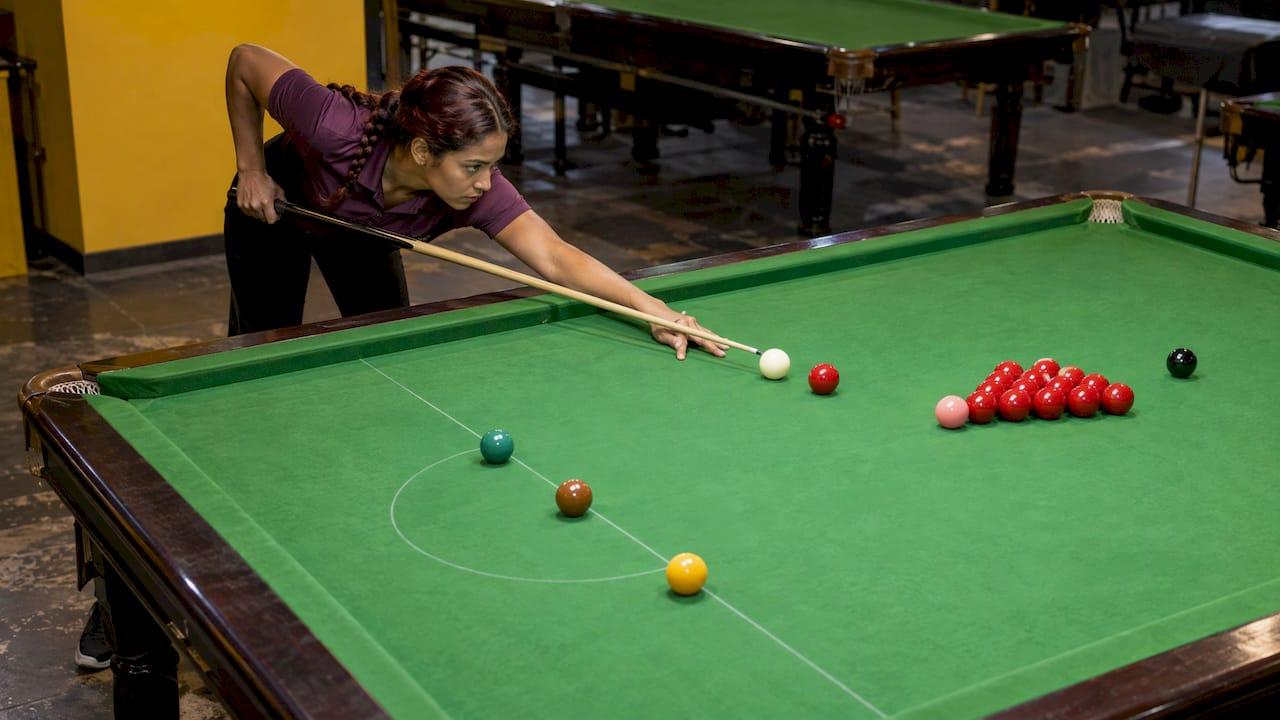
The snooker break-off is the first shot of a frame. You place the cue ball in the D, hit the outer edge of the red triangle, and send the white back down the table so your opponent has nothing easy to play. Done well, it costs you nothing and puts the pressure on the other player. Done badly, it hands over points before anyone has potted a ball. This guide covers the rules, the shot itself, the fouls to avoid and how the opening leads into your first break. It also covers how long a session lasts. You can practice all of it on our snooker tables at Q Billiards Arena in Houston.
TL;DR
- Play from in-hand anywhere on or within the D, and the first ball the white touches must be a red. Hitting a color first, missing everything or potting the white is a foul.
- The classic opening is a thin contact on the outer red, then the white returns to the baulk cushion. Control beats power.
- The cue ball's final position matters more than how far the reds spread. Leave your opponent a long, awkward shot.
- A break is the run of points you score in one visit. It ends when you miss, pot nothing or foul.
- Plan a club session around frames, not the clock: a frame can run from about half an hour to well over an hour.
Table of Contents
- What the break-off is and what the rules say
- Setting the table before you shoot
- How to play the standard break-off shot
- When the opening goes wrong
- Safe or attacking: choosing your opening
- From the opening shot to break building
- How long is a snooker session?
- Practice your break-off in Houston
- Our view: the opening shot is a skill worth a whole session
- FAQ
- Sources
What the break-off is and what the rules say
A frame of snooker begins with the cue ball in-hand. That means you may place it yourself, rather than playing it from where it lies. The white must be struck from a position on or within the lines of the D, the semicircle at the baulk end of the table. From there you can play in any direction, as long as the first ball you touch is a red. The WPBSA rulebook, the governing body's official text, is the reference for all of this. The WPBSA is the World Professional Billiards and Snooker Association.
Two things surprise newcomers.
- You do not have to pot anything. The opening shot is not a scoring shot. Nobody expects a red to drop, and with 15 reds packed tightly, one rarely does.
- The white does not have to touch a cushion. The only requirement is contact with a red. Cushions come into it because they are how you get the cue ball safely back.
Because the other 21 balls are still on the table, the opening is purely tactical. You are choosing where to leave the white, and your opponent has to answer from there.
Why the first shot is a safety shot
With the triangle intact and the pink sitting in front of it, the reds form a wall. From anywhere in the D you are effectively snookered on the reds, since the colors and the packed reds are in the way of a clean pot. So the sensible goal is a safe return: hit the pack thinly, bring the white back to the baulk end and leave nothing on.
Setting the table before you shoot
A good break-off starts with a correct rack. The reds form a tightly packed equilateral triangle. The apex red sits on the table's centre line, as close to the pink as possible without touching it. The colors sit on their own spots.
Three details matter to the player at the table:
- Keep the apex red off the pink. If the two touch, the ball you were meant to leave alone has been disturbed.
- Tight does not mean squeezed. The reds should sit snugly against each other. Jamming the triangle so hard that the balls press into the cloth can leave small impressions that cause bad bounces later. A neat triangle and an even hand are enough.
- Center line alignment. The line through the middle of the reds should run along the pink, blue and brown spots. A crooked triangle changes how the pack opens.
We go deeper on this in how to rack snooker balls correctly. If you have never racked a snooker frame, read that first. And if you want the point values of every ball before you start, snooker ball values for club players lists all 22.
How to play the standard break-off shot
The traditional opening is called the fine cut. It is the shot most club players should learn first because it is repeatable and safe.
Step 1: Place the cue ball
Set the white in the D, commonly on the line between the brown and the green, or a little to one side. Many players put it near the baulk cushion's side, so the angle to the outer red is gentle. Find a spot you like and use it every time. Consistency is the whole point.
Step 2: Choose your contact point
Aim for the edge of the triangle, on the outermost red on one side. You want a thin contact, a fine cut. A full-ball hit drives the white straight into the pack and bounces it unpredictably. A thin contact barely disturbs the reds and sends the white off at a controlled angle.
Step 3: Set your speed
This is the step most players get wrong. You do not need power. Use a smooth, medium pace, enough for the white to travel to the top cushion, bounce, and come back down the table. Too soft and it stops in the middle of the table, leaving your opponent an easy shot. Too hard and it can run into the pack or rebound too far.
Step 4: Mind your cue ball spin
A touch of side spin can help the white leave the cushion at the angle you want, but a little goes a long way. Heavy side spin with backspin shifts the cue ball sideways during the approach, which makes the contact thicker than you planned. For your first few attempts, hit the cue ball slightly above center or at center and add spin later.
Step 5: Aim for a landing zone
The aim is to bring the white back to rest near the baulk cushion, around the green or yellow spots, with the reds still mostly intact. The opponent then faces a long shot with nothing to pot. Think about where the white ends up after it hits the top cushion and returns, not only where it first meets the red.

This is the key idea in the break-off: treat the cue ball as a shield. The reds scattering is a bonus, not the target.
When the opening goes wrong
The break-off is easy to foul. Common mistakes:
- Missing every red. If the white does not touch a red first, it is a foul. The table is not reset and the frame is not restarted. Play continues from the position that results.
- Hitting a colour first. The first ball touched must be a red. Catching the pink on the way is a foul.
- Potting the white. A cue ball that drops in a pocket is a foul, and you will have given away points for nothing.
- Playing from outside the D. The white must be struck from on or within the lines of the D.
The cost is real. The WPBSA penalty schedule sets a base foul at four points. It sets higher penalties, equal to the value of the ball concerned, for acts such as missing all object balls, potting the cue ball or hitting a ball that is not on. Four to seven points is a big gap in a tight frame, and it happens before a single red is potted. Our guide to snooker fouls club players need to know goes through the full list, and cue ball fouls and how to avoid them covers the most common ones.
Two practical points. First, in friendly club play, agree on the rules before you start. Casual games sometimes use a simplified penalty. Second, if the opening shot leaves the white somewhere awkward, accept it and play on. A poor opening is not a reason to rack again.
Safe or attacking: choosing your opening
In professional snooker, players have experimented with more aggressive break-offs that split the pack harder. For a club player the fine cut remains the best default. Here is why.
| Approach | What it does | Best for |
|---|---|---|
| Fine cut, white back to baulk | Disturbs few reds, leaves the opponent a long shot | Most club players, most frames |
| Thicker contact, medium pace | Opens the pack slightly more, less control over the white | Players who are comfortable with longer pots |
| Hard break into the pack | Spreads reds widely, hard to predict where the white stops | Rarely worth it before you have mastered control |
The tradeoff is simple. The harder you hit, the less you control the cue ball. Since there is no scoring on the opening stroke, control is what you are paying for.
If your opponent leaves the white near the baulk cushion, you have a decision. You can play safe and return the pressure, or you can try a long red if the angle is on. A long red that misses can leave the pack open for your opponent. A careful safety exchange is part of the game, and most frames between club players are decided by who handles those exchanges better.
From the opening shot to break building
A break is the number of points scored in a single visit to the table. Once someone pots a red, the frame comes to life. Per the WPBSA rulebook, after a red is potted, the same player continues with a color of their choice. If it is potted, it is scored and returned to its spot. The break continues by potting reds and colors alternately until the reds are all gone. Then the colors are played in ascending order of value and stay off the table.
The visit ends when you fail to pot a ball or commit a foul. Your opponent then plays from where the white has stopped.
How good breaks are built
A high break is not about long pots. It is about positional play, which means leaving the white where the next ball is easy.
- Plan two balls ahead. Before you pot a red, decide which color follows and where the white needs to be after the pot.
- Favor the black early. The black is worth seven points, and its spot is close to the top cushion. Many players take the black after each red when they can, because it scores the most. Think about the next red as well as the black itself.
- Keep the cue ball central. A white that sits in the middle of the table has more routes to more balls than one stuck near a cushion.
- Open the pack deliberately. Reds in the pack that are stuck together are hard to pot. Use a colour shot to nudge a red free when the position allows.
- Do not rush. Slow, even strokes build breaks. Speed drops them.
For how points are tallied, our snooker scoring guide explains the arithmetic. If you want to know how a player can reach the famous 147 and beyond with a free ball, see our piece on the 153 break and the free ball rule.
Snookers and safety
Once the frame is underway, leaving the white behind a ball that is not on, so your opponent cannot hit a red directly, is a standard tactic. It is called a snooker. When one player is further behind than the points left on the table, laying snookers to win points from fouls becomes the main plan. The break-off is where this habit starts: you are leaving a position, not just striking a ball.
How long is a snooker session?
A snooker frame has no fixed length. A frame continues until all balls are cleared or the trailing player concedes. That makes it longer than a rack of nine-ball or eight-ball. At a club, a frame between two players of similar level commonly runs from about half an hour to well over an hour. Experienced players finish quicker, and tight, tactical frames run longer.
Professional formats show how much the format sets the clock. The WPBSA's Shoot Out rules cap each match at 10 minutes, with the clock starting at the opening stroke, and a shot clock of 15 seconds applies after the first five minutes. That is the exception, though. Your club game has no clock beyond the one you set.
Pacing a session
At an hourly table, you are paying for time, so a little planning helps.
- Plan in frames. Two frames in an hour is a realistic target for a relaxed game. A third is possible with quick play.
- Warm up before the first frame. Five minutes of break-off practice and long pots beats losing the first frame to a cold cue arm.
- Take short pauses. Between frames, rack, chalk and reset. Do not rush the rack, because a careless triangle spoils the next break-off.
- Watch your focus. Concentration fades after a couple of hours. If your safety shots start to drift, take a break and eat something.
- Agree on a finish. Decide before you start whether you are playing a set number of frames or until a set time, so nobody has to stop mid-frame.
Our tables are rented by the hour, so you can build a session around the number of frames you want. Standard Snooker is $15 per hour, and Heated Snooker is $20 per hour.
Practice your break-off in Houston

The break-off is a shot you improve by repeating it. Rack the reds, place the white, play the fine cut and see where the white lands. Do it ten times, then change the speed. You will quickly learn how much pace brings the white back to baulk.
At Q Billiards Arena you can do that on Standard Snooker tables for $15 per hour or Heated Snooker for $20 per hour. We have 25 professional-grade tables, and our late hours run until 2 to 4 AM. That suits players who want to practice after work or after a night out. Food and drinks are on our menu, so a long session does not need to end when you get hungry.

When your break-off is ready for competition, the 1-Red Snooker Tournament costs $20 to enter. For a group night, the poker room is available for private events, and the Snooker Coaching Camp is listed on our events page. See all our games or visit Q Billiards Arena for the latest.
Our view: the opening shot is a skill worth a whole session
Most players treat the break-off as something to get out of the way. We see it as the cheapest practice in snooker. It has no pot to miss and no pressure from a break in progress, and it teaches the three things that decide frames: contact, pace and cue ball position.
Our advice is simple. Spend the first fifteen minutes of any snooker hour on the break-off. Rack properly, play the fine cut, and aim to stop the white near the baulk cushion. Then play the frame. You will feel the difference by the second one.
That is one reason we built Q Billiards around a wide choice of tables and games and late hours. With 25 professional-grade tables, you can warm up on American Pool at $10 per hour, move to Standard Snooker at $15 per hour, and finish with a frame on Heated Snooker at $20 per hour. Whether you play for fun or for the weekly tournaments, the best snooker habits come from time at the table.
Q
FAQ
What are the rules for the break-off in snooker?
The first player places the cue ball anywhere on or within the D and plays it in any direction, but the first ball touched must be a red. Hitting a color first, missing all the balls or potting the white is a foul. No pot is required, and the cue ball does not need to touch a cushion.
How do you break in snooker?
Place the white in the D, aim for a thin contact on the outermost red of the triangle, and use a smooth, medium pace. The white should travel to the top cushion and come back to rest near the baulk cushion. This leaves your opponent a long shot and keeps the pack mostly intact.
What happens if you miss the reds on the opening shot?
It is a foul, and the penalty is at least four points. The table is not reset and the frame is not restarted. Your opponent plays on from the new position, or, if the white was potted, from in-hand.
Do you have to pot a ball on the break-off?
No. The opening shot is a tactical shot, not a scoring one. The only requirement is that the cue ball makes first contact with a red. Most break-offs are safety shots that pot nothing.
How long should I book a table for a snooker session?
Plan on roughly an hour for each frame if you are still learning, and a little less as you get faster. Two frames in a session is a comfortable goal for most club players. Since tables are hourly, you can extend if the game is close.