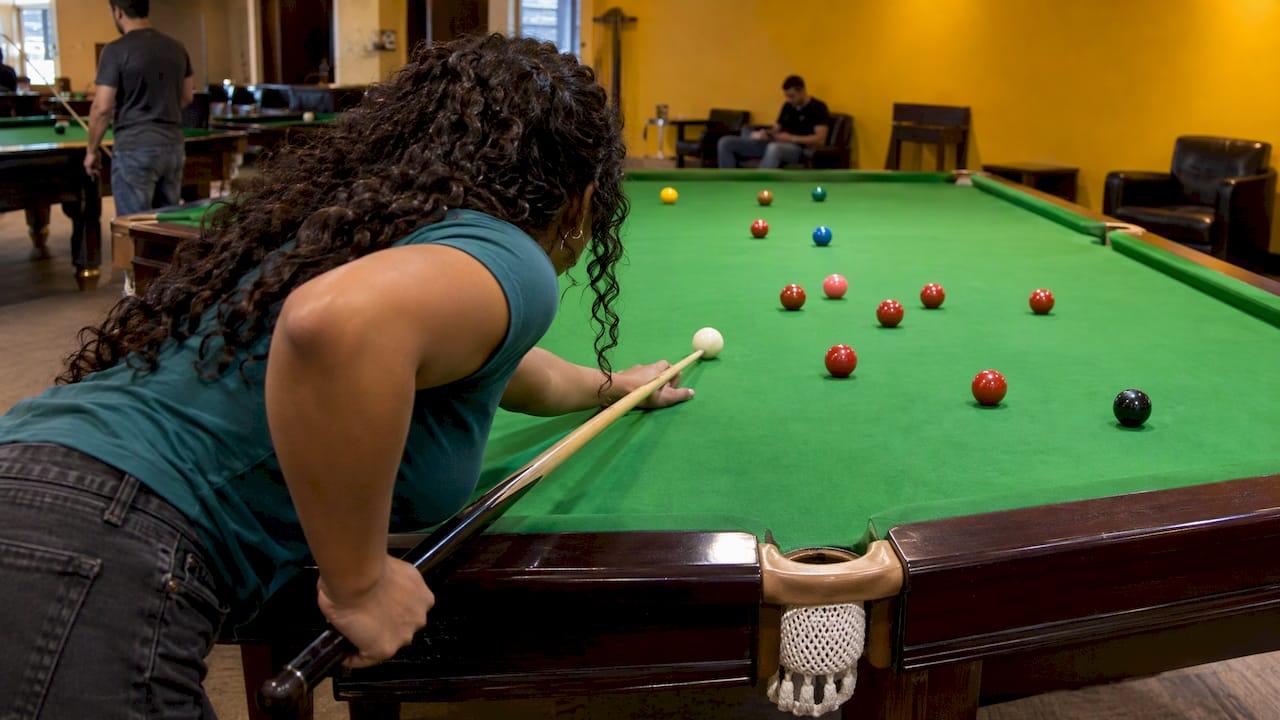
Snooker looks like pool on a bigger table, and that is exactly why first-timers struggle with it. The table is longer, the pockets are tighter, and you score by potting balls in a set order instead of simply clearing your group. Learn five things and your first frame will make sense: the table, the 22 balls, the potting order, the fouls and a straight cue action. This guide covers each one, so you can walk into a club in Houston and play a proper frame instead of just knocking balls around.
At Q Billiards Arena, standard snooker is $15 per hour, so you can try it with a friend and a plan rather than a big commitment.
TL;DR
- Snooker uses 22 balls: one white cue ball, 15 reds worth 1 point each, and six colours worth 2 to 7 points.
- You pot a red, then a colour, over and over. Once the reds are gone, you pot the colours in order from yellow up to black.
- Fouls cost the other player at least 4 points, so playing safe matters more than in pool.
- Straight cueing beats power. A relaxed grip and a steady backswing fix most beginner misses.
- Start with a one-hour session, a rack cue and a few simple drills before you play a full frame.
Table of Contents
- What snooker is, in plain terms
- The table and the 22 balls
- How a frame works
- Fouls, misses and snookers
- Grip, stance and straight cueing
- A first practice drill
- Snooker versus pool: what to expect
- Your first session at Q Billiards Arena
- Our view: start small, play often
- FAQ
- Sources
What snooker is, in plain terms
Snooker is a cue sport played on a baize-covered table with six pockets. Two players (or two teams) take turns at the table, and each visit is called a break. You keep going until you miss or foul. The player with more points at the end of the frame wins it, and a match is a set number of frames.
If you play American pool, the rhythm will feel different. Pool often rewards a fast, aggressive run of balls. Snooker rewards patience: where the white ball ends up after each shot matters as much as whether you pot the object ball. Experienced players think two or three shots ahead, and you can start doing that on your first night, one shot ahead at a time.
The table and the 22 balls
A full-size snooker table measures 12 ft by 6 ft. BBC Sport's explainer notes that this is larger than the 9 ft by 4.5 ft tables American professionals use for pool. The balls are also slightly smaller than pool balls, which makes long pots feel more demanding.
The same page lists the full set of 22 balls:
| Ball | How many | Points |
|---|---|---|
| White (cue ball) | 1 | none |
| Red | 15 | 1 |
| Yellow | 1 | 2 |
| Green | 1 | 3 |
| Brown | 1 | 4 |
| Blue | 1 | 5 |
| Pink | 1 | 6 |
| Black | 1 | 7 |
The 15 reds start in a triangle at one end of the table. The six colours each sit on their own marked spot. When a colour is potted while reds remain on the table, it comes back onto its spot. If you want a quick reference to keep on your phone, our snooker ball values guide lists all 22 at a glance.
As a beginner, you do not need your own equipment. Club rack cues and fresh chalk are the right place to start. The one habit to build from the first minute is chalking the tip before each shot, because chalk helps the tip grip the cue ball instead of slipping off it.
If you ever plan a table for your own space, our snooker table sizes guide explains how much room a full-size table needs.
How a frame works
The rule that confuses newcomers most is the alternating order. Following the WPBSA rulebook, the sequence goes like this:
- Pot a red. Every shot starts with a red as the ball on. Your first legal pot is always a red.
- Pot a colour of your choice. You can choose any colour, and you nominate it before you play. High-value colours are worth more, but they are harder to pot and harder to leave yourself position from.
- Repeat. Red, colour, red, colour. Colours go back on their spots while reds remain.
- Once the reds are gone, pot the colours in order. Start with yellow and finish with black. These colours stay down.
- Finish on the black. When black is the only ball left, the first pot or foul ends the frame. If the scores are tied, the black is re-spotted and the next pot or foul decides it.
A frame can also end early. The winner is the player with the highest score, or the player whose opponent concedes, or the player the referee awards the frame to.
In a friendly game, you will add up the score yourself. Our snooker scoring guide walks through points and breaks in more depth.
The maximum break
You will hear about the 147 as the perfect visit. BBC Sport explains it is made up of 15 reds, each followed by a black, then all six colours in order. It has happened more than 200 times in professional play, the first time by Steve Davis in 1982. It is a good trivia fact, but a beginner's goal is much smaller: a break of 10 or 20 is a real achievement.

Fouls, misses and snookers
The word "snooker" is also a situation. BBC Sport describes a snooker as the cue ball sitting where you have no clear sight of the ball you must hit next, so you have to plot a path around the table. Players do this deliberately to make the opponent's next shot hard. That is the tactical side of the game, and it is why snooker feels like chess with a cue.
Fouls are where beginners lose points. Under the WPBSA rules, a foul usually costs 4 penalty points. It costs more when a higher value applies:
- The value of the ball on, for things like a jump shot, potting the cue ball, or failing to hit any object ball.
- The higher of the ball on or the ball concerned, for hitting or potting a ball that is not on.
- Seven points for acts such as playing at reds in successive strokes.
After a foul, the next shot is played from where the white comes to rest, or in-hand if the white is not in play. The non-striker may also ask the offender to play again from the original position with the balls replaced.
There is also the miss call. BBC Sport explains that a referee may call a miss if you do not hit the correct ball and are judged not to have made a good enough attempt, usually from a snookered position. Your opponent then gets the foul points and can make you replay the shot.
For casual games, agree two things before you start: whether you will play the miss rule, and who keeps score. Our guide to the fouls club players need to know is a good companion for your first few frames, and the free ball explainer covers one of the more unusual situations after a foul.
Opening the frame
In snooker, the first shot is not a power break like in pool. You play the white from the baulk end, usually aiming to touch the back of the red triangle lightly and return behind the baulk line, so your opponent gets nothing easy. Our snooker break-off guide shows how to do it legally and well.
Grip, stance and straight cueing
Most beginner coaching comes down to one idea: send the cue through the ball in a straight line. The coaching clinic at SDB&SA in Australia stresses that straight cueing and getting through the cue ball are what matter, and that there is no single right grip. A grip is correct if it lets you play the cue in a straight line and reach all the shots you need.
European coaching material from the EBSA Erasmus+ project gives useful starting points:
- The thumb and first finger form a ring that makes up about 80% of the grip.
- The grip should hang vertically from the elbow.
- About 90% of your aim comes from getting behind the shot properly before you come down onto the cue.
- The most common fault is gripping the cue too tightly.
A practical way to apply this: set up behind the shot standing tall, look down the line of the cue, then lower your body without moving your head sideways. Hold the cue like you are holding a small bird: firm enough that it cannot escape, loose enough that it can breathe. Take two or three slow practice swings, pause briefly at the end of the backswing, then deliver the cue through the ball.
A first practice drill
The best way to learn straight cueing is a drill that exposes crooked cue action immediately. John Spencer's classic book Spencer on Snooker suggests placing the cue ball on the brown spot and aiming over the blue, pink and black spots so the ball rebounds off the top cushion and comes back along the same line. Start slowly, then build to medium pace with that brief pause at the end of the backswing.

If the white returns to your tip, your cue action is straight. If it drifts to one side, your grip, stance or cue delivery is moving off line. Repeat it for ten minutes at the start of every session. It is not exciting, but it is the quickest way to improve.
After that, try three simple tasks:
- Place a red a foot from a corner pocket, put the white in a straight line behind it, and pot it. Repeat from different angles.
- Pot a red, then try to leave the white somewhere you can reach a colour. Do not worry about the score, just watch where the white stops.
- Play a short frame with only a few reds on the table. It teaches the red-colour rhythm without a 20-minute commitment.
Snooker versus pool: what to expect
A pool player usually adapts quickly to the idea of potting, but not to the scale. In a US-focused article, cue maker Mark Richard observes that a beginner who looks competent on an American pool table may feel helpless at a snooker table because the pockets look tiny, the balls are smaller, the table is longer and the demands on position and shot power are higher.
That does not mean you should wait. It means you should set expectations: your first hour is about learning distances, not clearing the table. Expect to miss long pots, expect the white to run off line when you hit too hard, and expect position play to feel harder than in pool. Players with a good pool foundation often find their cue action carries over well, and the patience you build in snooker will help your pool game as well.
Here is how the two compare for a first-timer:
| American pool | Snooker | |
|---|---|---|
| Table | 9 ft by 4.5 ft at pro level | 12 ft by 6 ft |
| Balls | Slightly larger | Slightly smaller, 22 in total |
| Pockets | More forgiving | Tighter |
| Style | Faster, powerful breaks | Patient, position and safety play |
| Cost at Q Billiards Arena | $10 per hour | $15 per hour (standard snooker) |
If you want to move between cue sports in one evening, Q Billiards Arena also offers Chinese 9-ball and carom billiards, so a group with mixed tastes can all find a table.
Your first session at Q Billiards Arena
If you want to try snooker in Houston, our hourly rates are published on the games page: American pool is $10 per hour, standard snooker is $15 per hour, and heated snooker is $20 per hour. Chinese 9-ball and carom billiards are each $15 per hour.
We are a Houston billiards club with 25 professional-grade tables across American pool, snooker, Chinese pool and carom billiards, a fresh food and drink menu, and late-night hours until 2 to 4 AM. That makes it easy to fit a first session around work, or to come in after dinner with friends. There is also a promotion of free pool with an equal purchase. You can check the menu before you arrive, and if you are planning a larger evening, our poker room can be rented for private events.
A simple first-night plan:
- Book one hour of standard snooker and bring one friend.
- Spend the first 15 minutes on the straight-cue drill above.
- Play a short frame with six reds, then add the full 15 once you are comfortable.
- Order food and drinks between frames and talk through any rules you were unsure about.
When you want a goal beyond casual play, the 1-Red Snooker Tournament has a $20 entry fee, and the Snooker Coaching Camp is listed on our events page. Our tournaments page shows what else is running, including pool nights on Tuesdays and Fridays at $10 per entry.
Our view: start small, play often
We see snooker as the most rewarding cue sport to learn, and the way in is smaller than people think.
The mistake we hear about most is jumping straight to a full frame on a full-size table. Instead, get comfortable with the table first. Spend one hour on straight cueing, a few shots from the brown spot, and a short frame with a handful of reds. Then come back and do it again.
That is why we built Q Billiards Arena around variety and long hours. With 25 professional-grade tables, you can play American pool one night and snooker the next, and stay as late as you like with food and drinks at hand. Our weekly tournaments give you a reason to sharpen your game once you are ready, and the friendly crowd makes the first visit easier.
Pick a table, pick a friend, and book an hour.
Q
FAQ
Is snooker harder than pool?
For most beginners, yes at first. The table is bigger, the pockets are tighter and position play matters more. Pool players usually pick up the cue action quickly, so the gap closes with regular practice.
How long does a snooker frame take?
A casual frame between beginners can run from about 20 minutes to well over an hour, depending on how many reds you play and how many safety shots you trade. Starting with fewer reds keeps early games short.
Do I need my own cue?
No. Club cues are the normal place to start, and you can think about a personal cue once you know what weight and feel you prefer. Remember to chalk the tip before each shot.
What is the easiest way to remember the potting order?
Think red, colour, red, colour until the reds are gone, then yellow, green, brown, blue, pink, black. The point values rise from 2 to 7 in that same order, which makes the sequence easy to recall.
Sources
- BBC Sport: What is snooker? Rules, points, colours and set-up
- WPBSA Rulebook 2024-25: Snooker and English Billiards
- EBSA Erasmus+ project coaching material
- SDB&SA snooker and billiard coaching clinic
- Spencer on Snooker
- Mark Richard: Why Hasn't Snooker Taken Off in the USA?