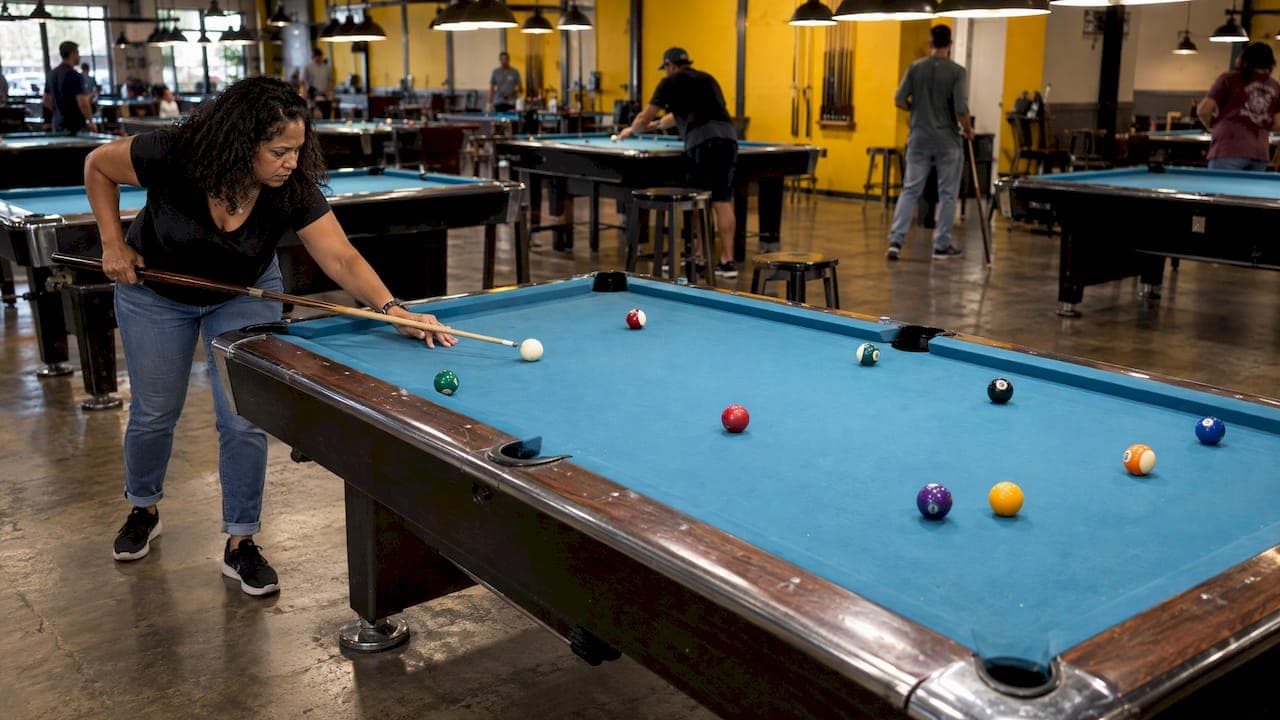
You don't need an opponent to get a real game out of a pool table. Ghost pool, 14.1 straight pool, bowlliards, speed pool and a handful of timed or scored drills all work with one player, one cue and a full rack. Pick one that gives you a number to beat, play it for a few sessions, and write the result down. That is the whole method. The rest of this guide covers the rules, the setup and how to make each game harder as you improve.
TL;DR
- Best solo games for a full table: ghost pool, 14.1 straight pool, bowlliards, speed pool and solo 8-ball.
- Best for skill building: stop, follow and draw drills where the difficulty changes after every result.
- Every solo game needs a score: a high run, rack wins out of 10, a time or a success rate out of 20.
- No table nearby? Grip, bridge and pre-shot routine can be rehearsed at home, and apps can fill the gap.
- At Q Billiards Arena in Houston, American pool is $10 per hour, so a solo session is easy to budget.
Table of Contents
- What counts as a solo pool game
- What you need before you start
- Solo games you can play on a full table
- Drills that actually build skill
- How to score and track your progress
- A 60-minute solo session you can copy
- Playing without a table
- Perspective
- Table time for solo players at Q Billiards Arena
- Choosing the right solo game for your goal
- FAQ
- Sources
What counts as a solo pool game
A solo pool game is any routine with a clear start, a clear way to lose or finish, and a score you can compare next week. Casual banging balls around is fun, but it doesn't teach you much. A scored game does, because it tells you when you missed and by how much.
There are two families. The first are game-style solos, where you play a full format against yourself or a imaginary opponent: solo 8-ball, ghost pool, 14.1 and bowlliards. The second are drills, short repeated shots built to train one skill: stop shots, draw distance, cut angles. Most good practice sessions use both: a drill block to warm up and sharpen, then a scored game to test it under pressure.
What you need before you start
The equipment list is short. A regulation table that is twice as long as it is wide, a cue, chalk to prevent miscues and a full set of balls, according to Big Cat Cues. A clean, true-rolling set also helps with position play, which matters more in solo games than in casual ones, because you control every shot and the table has to behave consistently.
Two extras make solo sessions better:
- A notebook or phone note. Date, game, score. Nothing fancy.
- A rack you trust. A loose, gappy rack gives you a different break every time, and that wrecks any score you're trying to compare. Our guide to racking 8-ball the official way walks through a tight rack.
If you're heading to a hall, our pool hall essentials list covers what to bring.
Solo games you can play on a full table
1. Solo 8-ball
Rack all 15 balls with the 8 in the center, break, then clear one group and finally the 8. The official WPA rules define 8-ball with fifteen numbered object balls and the cue ball, where a player clears an assigned seven-ball group (1 to 7 or 9 to 15) before the 8-ball, and shots are called. Playing solo, choose your group after the break, call every pocket, and count it a loss when you miss a call.
Score it by how many racks you complete out of five attempts. If you want to think about patterns first, our 8-ball strategy guide explains why you plan backward from the eight.
2. Ghost pool
Ghost pool turns you against an imaginary opponent who never misses. You shoot until you miss, then the ghost clears the table and wins that game. You win only by running the rack yourself. It works with 8-ball or 9-ball.
Ghost pool is easy to measure. Dooly's ghost-practice guide describes two formats: record your rack wins over a fixed set such as 10 games, or count the balls you pocket before your first miss. Its progressive version adds balls after successful sets and removes them after a failed one. Because the rule stays constant, a change across dated sessions actually means something.
3. 14.1 straight pool
This is the classic scoring game for one player. Under the WPA rules, each legally called pocketed ball scores one point, and after fourteen balls are pocketed the balls are re-racked and play continues. Solo, your score is your high run before a miss. Billiard Beast notes that serious players often use 14.1 to measure progress objectively through high runs.
The trick is the re-rack: when one ball remains, rack the fourteen others and keep the run alive. Learning to leave the last ball and cue ball where you can break the new rack open is a skill you can only get from this game.

4. Bowlliards
Bowlliards borrows bowling's scoring. You use 10 balls, get two innings per frame to clear them, and a perfect score is 300, per Billiard Beast. It's a fun way to play ten frames in a session and finish with a total, and it punishes sloppy leaves because a spare needs a clean second inning.
5. Speed pool
Speed pool is a timed game: clear the table as fast as you can, either beating a set timer or your previous record. Use your phone's stopwatch. Add a penalty rule (say, five seconds for each scratch) so you don't just slam balls. It is a good finisher for the end of a session, when your stroke is warm and you want some pressure.
6. Cowboy pool
Cowboy pool uses only the 1, 3 and 5 balls and races you to exactly 101 points through pocketing, caroms and combinations, according to Billiard Beast. The exact-total rule makes the endgame tricky and keeps it interesting after a few attempts.
7. Solo 3-ball
Place three balls and pocket them in as few strokes as possible. Pool Table Portfolio describes a version that starts with ball in hand and emphasizes three pockets in as few strokes as possible. A common house version counts the break as a shot and a scratch as two. Play ten sets, add up strokes and try to lower the total. It is short, fast and shows quickly whether your position play is any good.
8. Fifteen in a row
Pocket one ball on every shot after the break, with no misses. In the called-shot version, you restart if a different ball drops than the one you named. Try it with one rule: you may not touch a rail with the cue ball on the shot after the break. It trains thinking two balls ahead.
9. One-pocket, solo
One-pocket gives each player a foot pocket, and under the WPA rules the rack winner is the first to score eight object balls in that pocket. Solo, you only play toward one pocket and count how many shots it takes to get eight in. It teaches patience, bank shots and safe play better than any other game on this list.
Drills that actually build skill
Games tell you where you stand. Drills fix it. The best ones share one idea: the difficulty adjusts to you.
Progressive drills
Bob Jewett's progressive-practice guide recommends changing the shot after each result: harder after a success, easier after a miss. In his draw drill the object ball stays near a corner pocket, the cue ball starts one diamond away, and the required draw distance moves by a diamond after a success or half a diamond after a miss. Where you end up estimates the point where you succeed about half the time. That makes it a useful number to log, and it prevents you from memorizing one easy setup.
Cue-ball control ladder
The Pacific Northwest Cue Ball Association's cue-ball-control sequence starts with straight stop shots, then follow shots at about 6, 12, 18, 24 and 36 inches, then draw distances of 6 inches and 1, 2, 3 and 4 feet. The emphasis is smooth speed rather than force. If your draw dies at two feet, you have found your next month of practice.

Stop-shot count
A beginner-friendly version, from CueBallPath, puts the cue ball on the head spot and the object ball on the center spot. You shoot 20 stop shots and count how many leave the cue ball within a chalk-width of the contact point. Its stated benchmark is 16 of 20. Even if you never reach it, the count gives you a baseline.
Half-ball repetition
US Team Billiards' half-ball drill uses a precisely marked setup and suggests 90 repetitions per day for five days, concentrating on stroke delivery rather than just pocketing. Its point is worth keeping: good practice reduces misses, it doesn't eliminate them.
How to score and track your progress
A score without a record is a mood. Keep one line per session:
| Game | What you record | Example entry |
|---|---|---|
| Ghost pool | Rack wins out of 10 | 3/10 |
| 14.1 | High run in the session | 11 |
| Bowlliards | Ten-frame total | 96 |
| Speed pool | Best time, with scratches | Table cleared, 2 scratches |
| Stop-shot drill | Successes out of 20 | 13/20 |
Compare by table and by day, as the progressive-practice guide suggests. If you prefer an app, PoolStats tracks solo drills and sessions, including attempts, best results and level for each drill, plus match stats such as longest run.
One honest caveat from Dooly's guide: a ghost drill measures how often you convert a full rack, not every part of your game. Pair it with a drill block so you cover position and speed as well.
A 60-minute solo session you can copy
- Minutes 0 to 10: warm up. Straight stop shots and a few follow shots from the cue-ball ladder.
- Minutes 10 to 25: one drill. Progressive draw drill, or 20 stop shots with a count.
- Minutes 25 to 45: one scored game. Ten ghost games, or 14.1 for as long as your run lasts.
- Minutes 45 to 55: speed pool. Two timed clears for pressure.
- Minutes 55 to 60: log it. Write down three numbers and one thing to fix next time.
If you pay by the hour, this plan pairs well with our notes on planning every hour at the hall.
Playing without a table
No table today? You can still work on grip, bridge and pre-shot routine at home using a mirror or a flat surface, as Dr. Dave explains. He also suggests working on the mental game and watching instructional videos.
For actual play, there are digital options. CueVerse offers solo practice tables where you can drag and drop balls, undo moves, save layouts and play against computer opponents at different difficulty levels. Apps are handy for learning layouts and patterns. They don't replace feel: cloth speed, cue-ball roll and your own stroke only come from a real table.
Perspective
We see solo players at the hall every week, and the ones who improve fastest are the ones who treat a table like a gym, not a stage. Give yourself a plan, a number to beat and enough room to repeat a shot twenty times without anyone waiting.
That is why we built Q Billiards Arena around space and choice. With 25 professional-grade tables across 11,000 square feet, you can set up a ghost game on American pool, try 14.1 on a different table, or step up to snooker when you want a bigger challenge. Our late hours, which run until 2 to 4 AM, suit players who like to practice when the room is quiet.
When you're ready to test your game against real opponents, our weekly tournaments are the next step. Solo practice is where you build the shots. A bracket is where you find out they hold up.
Q
Table time for solo players at Q Billiards Arena
Solo practice is easiest when the table is ready and the clock is simple. Our American pool tables are $10 per hour, standard snooker and Chinese 9-ball are $15 per hour, carom billiards is $15 per hour and heated snooker is $20 per hour, all as published on our games and pricing page. We also run a free pool with an equal purchase offer, so ask at the counter what applies when you visit. Our menu has fresh snacks and drinks for the break between drill blocks.
When you feel ready to compete, the Tuesday and Friday night pool tournaments are $10 each, and details are on our pool hall page. New to hall etiquette? Read our guide on avoiding sharking and common hall manners before you come.
Choosing the right solo game for your goal
- You're a beginner. Start with solo 3-ball and the stop-shot count. Both are short and the numbers are easy to understand.
- You want to run racks. Play ghost pool and 14.1. They punish bad leaves and reward planning.
- You want a break from serious practice. Bowlliards and cowboy pool turn practice into a game.
- You're preparing for a league night. Solo 8-ball with called pockets, then ghost on 8-ball, because it matches the format you'll play.
- You like a challenge in a different game. Try carom billiards or Chinese 9-ball, both on our games list, or read about Chinese 9-ball in Houston.
Whatever you play, check house rules when you're away from home. The PBIA says house rules override other rule sets where local variations exist, so a quick question at the counter saves an argument later.
FAQ
Can you really get better at pool by playing alone?
Yes, if the practice is structured. Scored games and progressive drills give you honest feedback every shot, and tracking results shows trends you'd otherwise miss. Solo practice builds your shotmaking and cue-ball control, while match play adds pressure and decision-making.
What is the best solo pool game for beginners?
Solo 3-ball and the 20-shot stop drill are the gentlest starting points. They use few balls, take minutes and produce a clear number. Once you can pocket and control the cue ball reasonably, move to ghost pool and 14.1.
How long should a solo practice session be?
An hour is a solid block, split between warm-up, one drill, one scored game and a short log. If your focus drops, stop earlier. Quality repetitions beat a long, tired session.
Can I play pool alone at a pool hall?
Yes. Many halls rent tables by the hour, and solo players are common on quieter nights. At Q Billiards Arena you pay the hourly table rate, such as $10 per hour for American pool, and you can order food and drinks while you practice.
Sources
- WPA Rules of Play, effective January 2, 2026
- WPA Rules of Play, effective September 15, 2025
- PBIA, Games of Pocket Billiards
- PNCBA, 5 Pool Practice Drills to Improve Cue Ball Control
- Bob Jewett, Progressive Practice
- CueBallPath, Solo Pool Practice Routine for Beginners
- US Team Billiards, Training Drills
- Billiard Beast, How to Play Pool by Yourself
- Pool Table Portfolio, How to Play Pool by Yourself
- Dooly's, Playing the Ghost
- Big Cat Cues, How to Play Pool by Yourself
- PoolStats
- CueVerse, Pool Practice
- Dr. Dave, Practicing With No Pool Table