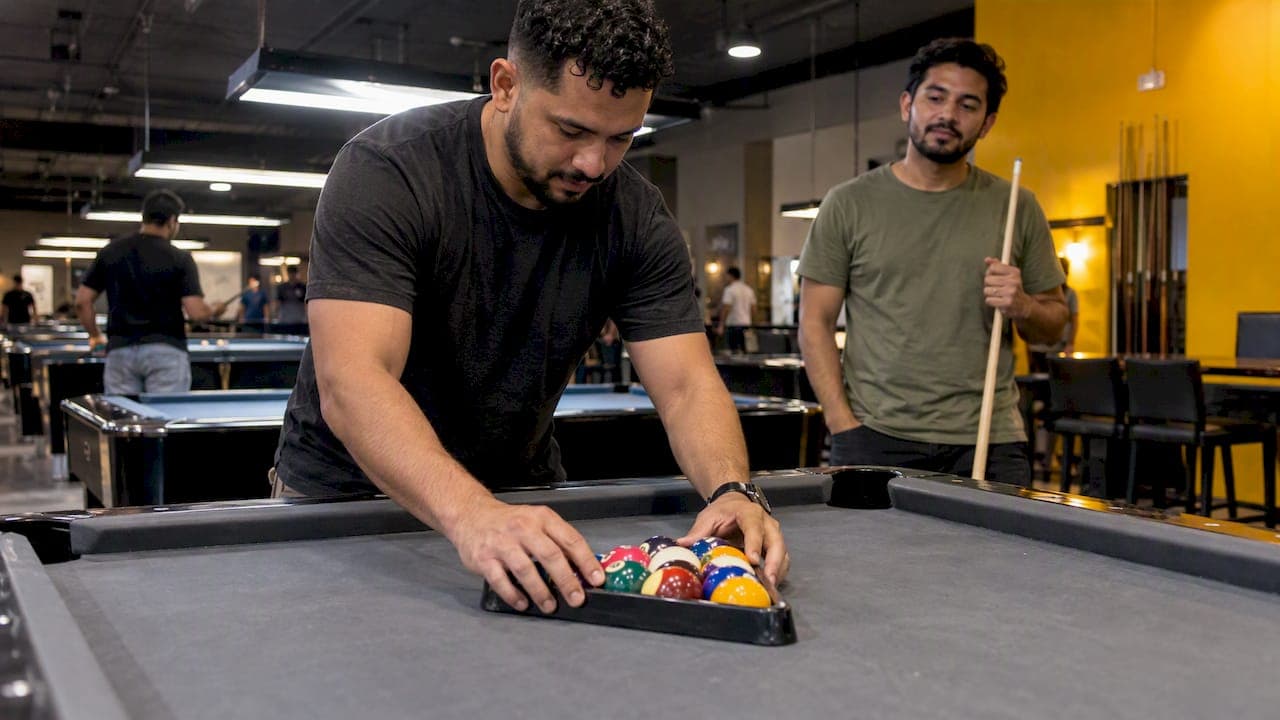
Good pool table time management comes down to three decisions made before you chalk up: how many hours you actually need, what game fits that window, and how you will keep the pace once the balls are rolling. Get those right and an hourly table feels like value. Get them wrong and you either pay for idle minutes or get cut off mid-rack.
This guide is for players, groups and small-event organizers who rent tables by the hour. We run a 25-table room in Houston, so the examples use our published rates and the way a real night unfolds. If you run a tournament, there is a section on clocks, grace periods and forfeits too.
TL;DR
- Budget by the hour, not by the game: at our published rates a table costs $10 (American pool) to $20 (heated snooker) per hour.
- Match the game to your window. A casual 9-ball set runs shorter than most people think, and snooker frames run longer.
- Set a grace period, a stop time and one person who watches the clock when you play in a group.
- In tournaments, strict start times (5 to 15 minutes) and match limits keep a bracket from collapsing.
- Late hours help: book the quiet end of the night when you want unhurried time on a table.
Table of Contents
- What time management means on a pool table
- Know what an hour costs before you start
- Match the game to the time you have
- Table size changes your pace
- A night plan that works
- Food, drinks and the clock
- Perspective: how we think about an hour
- Tournament time management for organizers
- Time at the table as a competitor
- Groups and private events
- Where Q Billiards Arena fits in
- FAQ
- Sources
What time management means on a pool table
The phrase covers two different jobs, and most pages mix them up.
For a player or group, it is the money-and-minutes question: how long to rent, what to play, and when to stop. The clock is running whether the cue ball is moving or not, so talk, ordering food and racking all cost something.
For an organizer, it is a throughput question: how many matches your tables can finish in the evening, and what you do when one runs long.
For a competitor, it is pace at the table. Some leagues use a shot clock and some do not. For example, APA-style local divisions generally have no shot clock, which lets players slow down when ahead and speed up when behind.
We cover all three below, starting with the one most readers need: planning a paid hour.
Know what an hour costs before you start
The simplest time-management tool is arithmetic. Here are our published hourly rates and what a longer session adds up to.
| Game | Rate | 1 hour | 2 hours | 3 hours |
|---|---|---|---|---|
| American Pool | $10 per hour | $10 | $20 | $30 |
| Standard Snooker | $15 per hour | $15 | $30 | $45 |
| Chinese 9-Ball | $15 per hour | $15 | $30 | $45 |
| Carom Billiards | $15 per hour | $15 | $30 | $45 |
| Heated Snooker | $20 per hour | $20 | $40 | $60 |
Rates are as published on our games page and can change, so check it before you plan a big night. Food and drinks are billed separately, and our menu has no published prices on the site, so ask when you order.
A quick way to use the table: divide the total by the number of people at the table. Four friends playing three hours of American pool pay $30 for the table, which is $7.50 each before food. The same group on standard snooker pays $45, or $11.25 each. Whether time is tracked per table or in another way is something to confirm at the counter when you check in, so there are no surprises at the end.

Match the game to the time you have
The most common mistake is picking a game that does not fit the window. Think of each game as having a natural length.
American pool and 9-ball
A single rack of 8-ball or 9-ball between two comfortable players is quick. The time sink is everything around the racks: socializing, rematches and chalk breaks. If you want to know how long a set really lasts, our breakdown of 9-ball match length puts real numbers on it. For most casual groups, one hour of American pool at $10 covers a couple of short sets, and a second hour is for rematches.
Snooker
Snooker is a slower game by design. A frame has 15 reds, colors in between and a long clearance, so beginners should plan on fewer frames per hour than they expect. Heated snooker at $20 per hour is a premium option, so it is worth using for a focused session rather than a casual chat. If you are new, book a single hour of standard snooker at $15 first and decide whether to extend.
Chinese 9-ball and carom
Both are $15 per hour. Chinese 9-ball plays on a different table feel and rule set from American 9-ball, so budget extra minutes in the first hour for learning the rules. Details are on our Chinese 9-ball page. Carom billiards has no pockets, so the game is about patience and position, and you will want a longer, quieter slot.
A rule of thumb
Plan your first hour as a warm-up and a decision point. If everyone is still engaged at the 45-minute mark, extend. If the group is mostly talking, switch to a shorter booking next time.
Table size changes your pace
Bigger tables take longer to play on. A professional 9-foot table has a playing surface of 50 by 100 inches, an 8-foot table is 44 by 88, and a 7-foot table is 38 by 76, according to the BCA equipment specifications listed by Dallas Pool Table. More area means longer shots, more safety play and slower racks for beginners.
If you are comparing sizes for a room of your own, our guide to pool table sizes and room requirements goes through the dimensions, and the snooker table size guide does the same for the bigger table. For a night out, it simply means this: if you want fast, social games, choose the smaller-format game, and if you want to practice for a tournament, choose the table that matches what you will compete on.
A night plan that works
Here is a template we suggest for a group of four. Adjust it to your group.
- Arrive 10 minutes early. Put your name down, pick your cues and order the first round of drinks before the clock starts working against you.
- Warm up for 15 minutes. Loose breaks and fun shots. No scorekeeping.
- Play timed sets. Agree on a format: race to three racks, or winner stays for two games. Decide before the first break.
- Order food at a natural pause. Place the order between sets, not in the middle of one, so you do not stall a shot.
- Set a hard stop. Pick a time, say the end of the second hour, and agree on who calls it.
- Settle up and book the next one. If it went well, tell the counter what you liked.
We also keep late-night hours, listed as running until 2 to 4 AM, so the end of the evening is not a rush. If you want a long, relaxed session, the later hours are usually less hectic than prime time. Check our home page for what is open tonight.
Food, drinks and the clock
People underestimate how much time goes to ordering and eating. A few habits help:
- Order shared plates or snacks that you can eat with one hand and without grease on the cue.
- Keep drinks off the rail and on the side tables.
- Let one person order for the group so the table never goes fully idle.
Our menu covers food, snacks, house special drinks, and cold and hot drinks, all served in the same room as the tables. That matters for time: you do not leave the game to eat.
Perspective: how we think about an hour
We look at the room every night, and the pattern is consistent. The groups who enjoy themselves most are not the ones who play the longest. They are the ones who decided up front what the night was for.
A first date wants a short, relaxed booking with a drink, and a second hour only if it is going well. A league player wants a long, quiet table to repeat one shot. A birthday group wants space, snacks and a loose format where nobody is keeping score. Those are three different clocks.
Our 25 tables are there so that you are not forced to squeeze into whatever is free. If a game is running long, you do not have to rush it to make room for someone else, and if you want to try snooker after pool, there is usually a table for it. We would rather you pick the right game and stay for a good hour than rush through three.
One more thing we say at the counter: decide who is watching the time. It is the cheapest tip in this article, and the one that saves the most money.
— Q
Tournament time management for organizers
If you are running an event, time is the whole game. A bracket that falls behind in round one will never recover.
Set a grace period and enforce it
Experienced directors use strict grace periods. The American CueSports Alliance league manual, for example, describes a standard grace period of 5 minutes before a match is forfeited, which stops one late player from delaying the rest of the bracket. Some events allow longer: the Derby City Classic rules give players 15 minutes to be at the table and ready after a match is announced, or they lose by forfeit. Choose a number that fits your crowd, publish it, and apply it to everyone.
Use match limits where games run long
Slow formats need ceilings. The same Derby City Classic rules set a 3-hour match limit for one-pocket, a game known for its slow pace, and large championships can run long days of play. A local 8-ball or 9-ball night rarely needs that, but a limit on race length does. A race to five is easier to schedule than a race to nine.
Track average game time
The most useful number for a director is average game time. Modern bracket software can calculate it live from completed matches, so you can see when a round is running over before the whole schedule slips. You can do the same with a clipboard: note the start and end of the first four matches, average them, and use that figure to estimate when the next round begins. Lower-skilled fields run slower, so recalculate every round.
Do the table math
Before you open registration, divide your available hours by your average match length and your table count. A 16-player single-elimination bracket has 15 matches. With four tables and matches that average 40 minutes, the full bracket takes about three rounds of table time plus a final. Our guide to 16-player match math and tournament formats walks through the options for single elimination, double elimination and round robin.

Run the room, not just the bracket
A few practical items prevent the little delays that add up:
- Post the schedule where players can see it.
- Call matches early and loud, then start the grace clock.
- Have spare chalk, a bridge and a rack at every table.
- Keep a runner for results so you are not walking back and forth.
For a fuller walkthrough, see our tournament checklist and the guide to hosting a tournament people enjoy.
Time at the table as a competitor
Pace is part of strategy. In leagues without a shot clock, you control the tempo. Slowing down when you are ahead and speeding up when behind is a common approach, as the league night strategy guide describes, but it only works if you stay within the rules of fair play and your league's own time rules. Read them before your first match.
Some habits help regardless:
- Decide the shot before you get down. Do not stand over the ball deciding.
- Use a consistent pre-shot routine. It is faster and steadier.
- Take your time on the shots that matter, and run the easy ones quickly.
- Walk away to reset after a mistake instead of replaying it at the table.
If you want structured practice, you can compete at our weekly events. The Tuesday and Friday night pool tournaments each have a $10 entry, and the 1-red snooker tournament is $20. Details are on the pool tournament page and the snooker page. Snooker players can also look at the coaching camp on our events page, which has no published price, so ask us directly.
Groups and private events
For a bigger party, the time problem changes. You are not managing one table, you are managing a crowd. Split the group into teams, rotate every game or two, and give the people waiting something to do: food, darts of conversation, or a second table.
If you need a closed room, our poker room rental is an option for events. It has no published price, and our business model uses either a minimum purchase or a paid reservation, so contact us with your date and headcount. Book early for weekends.
Where Q Billiards Arena fits in
If you want to put this into practice, we have 25 professional-grade tables across 11,000 square feet in Houston, with American pool, standard and heated snooker, Chinese 9-ball and carom billiards all on one floor. We also run a promotion of free pool with an equal purchase, so ask at the counter how it applies on the day you visit. See all games and hourly rates, or look at the tournaments and events page if you would rather compete than relax.
Still choosing where to play? Our guide on how to choose a pool hall for your goal lists what to compare, and the pool hall essentials post covers what to bring.
FAQ
How long should I book a pool table for?
For a casual group, one hour is a good first booking and two hours is comfortable for four people. Extend if everyone is still playing at the 45-minute mark. For snooker or a practice session, start with at least an hour, since frames and drills take longer than a quick rack.
How much does an hour of pool cost at Q Billiards Arena?
American pool is $10 per hour, standard snooker, Chinese 9-ball and carom billiards are $15 per hour, and heated snooker is $20 per hour. Rates are published on our games page and can change. Food and drinks are separate.
What is a fair grace period for a tournament?
Five minutes is a common standard in league play, and some large events allow up to 15 minutes after a match is announced. Pick one number, publish it before round one and apply it to everyone. A clear rule ends arguments and keeps the bracket moving.
How do I keep a pool night from running over budget?
Decide the number of hours and the stop time before you start, and name one person to watch the clock. Order food between sets rather than during play. Divide the table cost by the number of players so everyone knows their share in advance.
Sources
- Equipment Specifications, Dallas Pool Table
- Rules, Derby City Classic
- 2025-2026 ACS League Operator Manual
- Billiard tournament organizer FAQ, Budtour