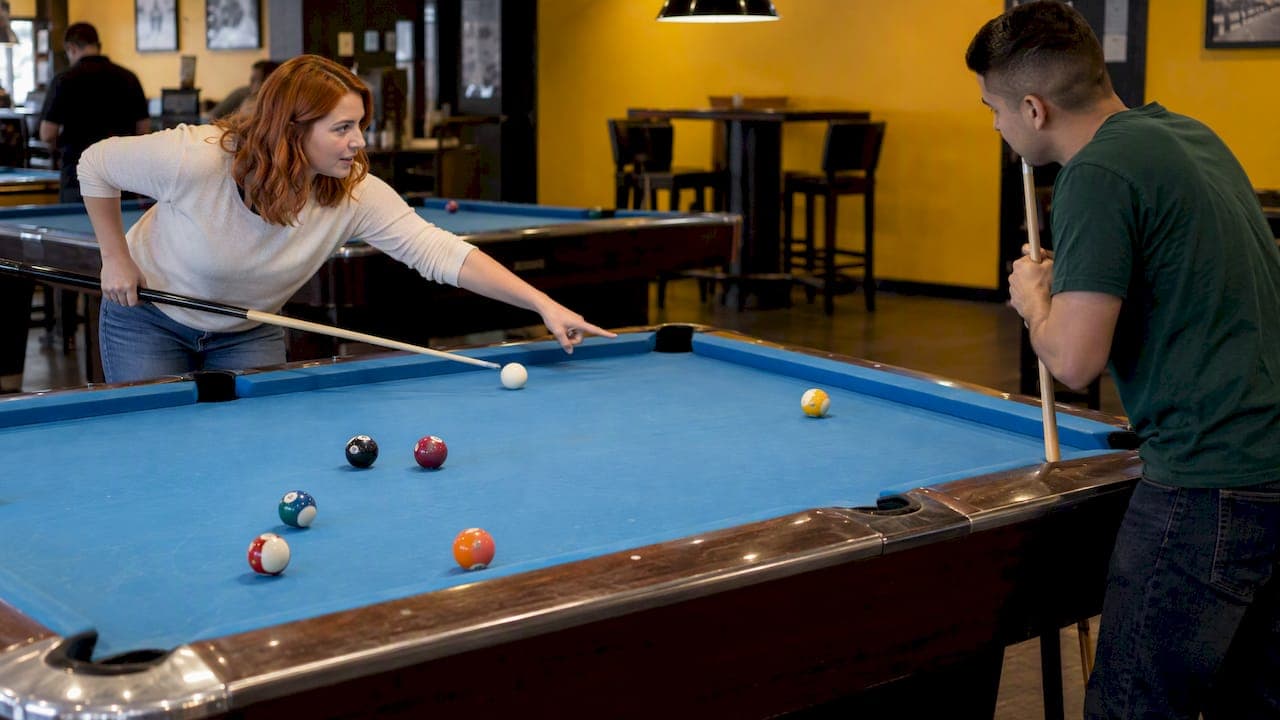
In a call-shot game, you must name the ball you intend to pocket and the pocket you intend to pocket it in before you shoot. You do not have to name the path, the cushions or the kisses. If the shot is obvious, most rulebooks let you skip the announcement. If there is any doubt, you call it. Rulebooks differ on the details, and those details decide arguments, so this guide walks through what the major rulebooks say and how to settle it with your opponent before the first break.
TL;DR
- Call shot means naming the object ball and the pocket before each shot. Nothing else needs to be called.
- Obvious shots usually need no call, but if there is any chance of confusion, say it out loud. Some leagues require a call on anything not obvious, however simple it looks.
- If the called ball does not go in the called pocket, your turn normally ends. Pocketing the 8-ball in the wrong pocket can cost you the rack under WPA rules.
- 9-ball is normally not a call-shot game, and APA league play has its own, more relaxed rule for 8-ball.
- Agree on the rulebook or house rules before you play, and ask staff if you are in a pool hall.
Table of Contents
- What call shot means
- What counts as obvious
- What happens when the call and the result do not match
- Fouls still apply in a call-shot game
- Call shot across games and leagues
- How to settle it before the break
- Habits that make calling easier
- Our view on calling shots
- Practice call shot in Houston
- Other cue sports have their own conventions
- FAQ
- Sources
What call shot means
The World Confederation of Billiards sports glossary describes the idea simply: a player must designate, in advance of each shot, the ball to be made and the pocket it will be made in. That is the whole definition. Everything else in this article is about the edge cases: what counts as obvious, how precise you must be, and what the penalty is when the call and the result do not match.
The point of the rule is to reward skill over luck. Without it, a hard shot that happens to drop a ball by accident would count the same as a planned one. With it, a player who slaps a ball around the table and sinks something gets nothing for it. Call shot is why serious 8-ball feels like a game of intention.
What you must say
Two things: which ball, and which pocket. In practice that sounds like "the 5 in the corner" or "the 12 in the side." You can point with your cue, tap the pocket or say it aloud. Speak clearly enough that your opponent could repeat it back.
Under the World Pool-Billiard Association rules, the intended ball and pocket must be indicated for each shot if they are not obvious. The same rulebook also allows a call of "safety" in 8-ball instead of a ball and pocket, which hands play to your opponent when the shot ends.
What you do not have to say
You do not need to call the route. Kern County's BCA league rules state that players do not need to call the path, the number of cushions, or details like kisses and combinations. Only the object ball and the intended pocket are required.
The BCAPL rulebook says the same about the two shots that look most complicated. When you shoot a bank or a combination, you are not required to specify the cushions or the sequence of balls, only the object ball you are trying to make and the pocket. So "the 7 in the far corner, off the rail" is more than you need to say, and "the 7, bank, far corner" works just as well.
What counts as obvious
Most rulebooks give you a break on shots nobody could misread. A ball sitting on the lip of a pocket with a clear path from the cue ball is a good example. The WPA wording is that if the ball and pocket are obvious, they need not be indicated, but if there is any chance of confusion the shooter should indicate them. If the referee or your opponent is unsure, either may ask you to call.
The catch is that "obvious" is a judgment, and judgments start fights. Some leagues take the judgment away. BCAPL emphasizes that players must always call shots that are not obvious, no matter how simple or clear the shot may look, precisely to avoid disputes.
A practical rule for casual games: if two balls are near the same pocket, or one ball could go in two pockets, or a ball sits near another ball it could touch, call it. If you hesitate for even a second over whether to call, call it. A five-word announcement costs nothing, and a disagreement over a pocketed ball can sour a whole evening.

What happens when the call and the result do not match
There are several versions of "it did not go as called," and the penalty depends on which one you hit.
The called ball misses
If the called ball does not drop, you have missed. Your inning ends and the table passes to your opponent. Nothing is a foul unless you also broke another rule, such as scratching. The opponent plays the balls where they lie.
Another ball drops, or the called ball goes in a different pocket
This is where rulebooks diverge. Depending on the rules, the shot may be treated as a foul or simply as an illegal pocketed ball, which costs you your turn and, in the worst case, the game. The WPA rulebook includes one case worth memorizing: if a player pockets the 8-ball in an uncalled pocket, they lose the rack. The 8-ball is the one ball where a wrong pocket is not a minor penalty, so be exact about it. Chalk or a marker on the pocket helps in leagues that ask for it.
You did not call a shot that needed a call
BCAPL has a specific consequence. If you do not call a shot that is defined as not obvious and you pocket a ball, your inning ends and the incoming player accepts the table in position. The ball you pocketed does not count for you as a legal call, and your opponent cannot ask for a replay. They shoot from wherever things landed.
You called more than one ball, or hedged
BCAPL also does not allow vague calls. If you name more than one ball or use conditional phrasing, your inning ends after the shot, regardless of whether you pocket a ball. So "the 3 or maybe the 6" and "the 4 in the corner, unless it hangs, then the side" are both wrong. One ball, one pocket, no "ifs."
| Situation | Typical result |
|---|---|
| Called ball misses | Inning ends, opponent shoots |
| Called ball goes in a different pocket | Turn lost, possible foul or loss of rack depending on rules |
| 8-ball pocketed in an uncalled pocket (WPA) | Loss of the rack |
| Not-obvious shot not called, ball pocketed (BCAPL) | Inning ends, opponent accepts table in position |
| Two balls or a conditional call (BCAPL) | Inning ends after the shot |
Fouls still apply in a call-shot game
Calling a shot does not change the foul list. If you foul while shooting a called ball, you lose the turn even if the ball goes in. According to WPA 8-ball rules, standard fouls include scratching the cue ball, shooting the wrong ball first, no rail after contact, and driving a ball off the table. The usual consequence is that your opponent receives cue ball in hand and may place it anywhere on the table.
League rules add more. Kern County's list includes jumping the cue ball off the table and failing to keep at least one foot on the floor during the stroke. Our own guides go deeper on this side of the game: cue ball fouls and ball in hand and 8-ball fouls that cost you the game.
Call shot across games and leagues
Not every pool game uses call shot, and leagues differ even on the same game. Know which one you are in.
8-ball
The WPA and BCAPL rulebooks treat 8-ball as a call-shot game. That is the standard for tournaments and for many serious league nights. APA, the most widely played amateur league in the US, is looser: its team manual says players are not required to call obvious shots in 8-ball, and marking the pocket is only required for the 8-ball. If you move between leagues, expect the same game to feel different. If you want a plan for how to run a rack, our 8-ball strategy guide works backward from the eight, and racking 8-ball covers the setup.

9-ball and 10-ball
Nine-ball is typically not a call-shot game, and a ball pocketed on a legal shot counts regardless of the pocket. APA 9-ball also does not require called shots. In APA, advice about which ball to shoot is considered coaching, which is restricted to allowed time-outs. Ten-ball is different: it is generally played as a call-shot game, so check the rules in play. We have a ten-ball quick reference and a guide to 9-ball breaks and push outs.
Straight pool and one pocket
Straight pool is a call-shot game: you call ball and pocket on every shot and score a point for each legal ball. One pocket is a different kind of game, because you are trying to sink balls in your own assigned pocket. Our guide to one pocket rules shows how calling works there.
Bar rules and house rules
In a bar or pool hall, you will meet "bar rules": a ball in any pocket counts, no call needed, and often some local twist on scratching the 8-ball. Casual players frequently skip call shot altogether because it adds a spoken step that can raise questions, which is why so many friendly games run without it. That is fine, as long as both players agree before the break. Not agreeing is where disagreements come from.
| Format | Call shot? |
|---|---|
| WPA 8-ball | Yes, unless obvious; "safety" can be called |
| BCAPL 8-ball | Yes, all not-obvious shots must be called |
| APA 8-ball | Not for obvious shots; pocket marked only for the 8-ball |
| 9-ball (most leagues, APA) | No |
| Straight pool | Yes |
| Bar rules | Whatever you and your opponent agree on |
How to settle it before the break
Most call-shot arguments are really arguments about which rulebook is in charge. Five questions, asked before the first shot, prevent nearly all of them.
- Whose rules? WPA, BCAPL, APA or house rules. In a league or tournament the organizer decides. In a casual game, pick one.
- Is every shot called, or only non-obvious ones? Say it plainly.
- How exact must the pocket call be? Pointing, tapping the pocket or speaking all work, but agree.
- What happens on a wrong-pocket 8-ball? The WPA says loss of the rack. Some house rules just say you lose your turn.
- What are the foul penalties? Ball in hand anywhere is the common standard, but confirm it.
If you are in a pool hall and the answer is unclear, ask staff what the house rules are. They can tell you what is posted and how disputes are usually handled. For general conduct around the table, including how to avoid sharking, see our pool hall etiquette guide.
Habits that make calling easier
- Call before you get down. Announce it standing, then settle into your stance. A call made mid-stroke is not a call.
- Be specific with a cluster. If several balls sit near a pocket, give the number, not "that one."
- Use the cue as a pointer. A quick tap at the pocket removes doubt about which one you mean.
- Call safeties as safeties. Where the rules allow a safety call, say "safety." Otherwise a ball that drops by accident may not help you the way you expect.
- Do not narrate your plan. Saying "the 4 in the corner, then the 6" can count as calling more than one ball under strict leagues. One shot at a time.
- Let your opponent ask. If they ask which ball and pocket, answer without arguing. The WPA rules say either the referee or opponent may ask when unsure.
Our view on calling shots
We run a 25-table room in Houston, and the pattern is the same night after night: games stay friendly when the rules are settled before the break, and they get tense when they are not. Call shot is the clearest example. It is a simple rule, but there are enough versions of it that two honest players can disagree about what "obvious" means.
Our advice is to practice calling the way you will be asked to call it in competition. If you plan to play in a tournament, play your practice sets with every shot called, ball and pocket, spoken out loud. It slows you down for a night and then it becomes automatic.
We also like a table you can learn on without pressure. American pool is the easiest place to build the habit, and snooker, Chinese 9-ball and carom each teach their own kind of discipline. Having all of them under one roof means you can move from casual racks to competitive nights when you are ready, and our weekly tournaments are a good first step.
Q
Practice call shot in Houston
The fastest way to get comfortable calling shots is to play them at a real table with a real opponent. At Q Billiards Arena, American pool tables are $10 per hour, and you can see the full list of games and hourly rates on our games page. When you want to test it under pressure, our Tuesday and Friday night pool tournaments have a $10 entry each.

Bring a friend, agree on the rules before the break, and call every shot for an hour. If you get hungry, our menu has food, snacks and drinks you can order while you play. For the full picture of what we host, see our tournaments and events.
Other cue sports have their own conventions
If you play more than one game, do not carry call-shot habits over automatically. Chinese 8-ball opens with a four-contact break and its own rules for what must be called, and our Chinese 8-ball guide covers it. Cutthroat is a three-player game where house rules matter even more, and our cutthroat pool guide lists the common fixes. Snooker and carom billiards have different rules from pocket games, so ask before assuming.
FAQ
Do I have to call the pocket for every shot?
Not always. Under the WPA rules, you need to indicate the ball and pocket only when they are not obvious, and if there is any chance of confusion you should say it. BCAPL goes further and requires a call on every shot that is not obvious. When in doubt, call it.
Do I have to call bank shots and combinations?
Yes, you call them like any other shot, but you only name the object ball and the pocket. BCAPL states that you do not need to specify the cushions or the sequence of balls. Calling extra detail is allowed, but it is never required.
What happens if I call a ball and a different one drops?
Your turn ends, and depending on the rules it may also be a foul. Pocketing a ball you did not call is not scored as a legal shot. In WPA 8-ball, sinking the 8-ball in an uncalled pocket loses the rack.
Is 9-ball a call-shot game?
Typically no. In most leagues, a ball pocketed on a legal shot counts whatever the pocket, and APA 9-ball does not require calling. If you are playing in a tournament, confirm it with the organizer.
Can I call a safety instead of a shot?
In WPA 8-ball, yes. You can call "safety" instead of naming a ball and pocket, and play passes to your opponent when the shot ends. Other leagues may handle safeties differently, so confirm the rule you are playing under.
Sources
- Billiards Glossary, World Confederation of Billiards Sports
- WPA Rules of Play, effective September 15, 2025
- Rules and Resources, Kern County BCA Pool League
- BCAPL Official Rules (CSI Pool copy)
- BCAPL Rulebook (QTime Pool copy)
- APA Team Manual