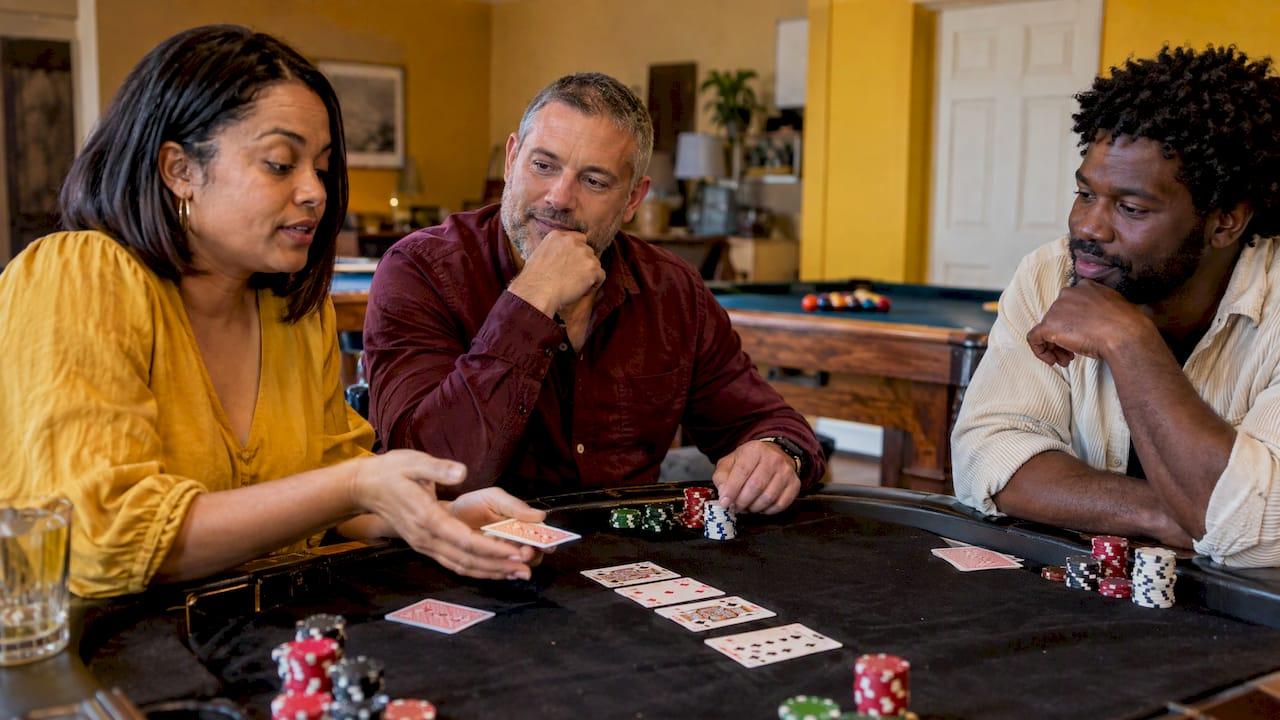
The best private poker variants are the ones everyone at the table can learn in one sentence: Texas Hold'em, Omaha, Seven-Card Stud and Five-Card Draw cover most nights, and Badugi or Pineapple add spice once the group is comfortable. The easiest way to use them is dealer's choice, where the deal rotates and each dealer names the game. This guide shows how the families differ, which games suit a friendly table, and how to agree the rules before the first card. If you want a room set up for it, our private poker room in Houston is built for exactly that kind of night.
TL;DR
- Every poker variant falls into one of three families: draw, stud or community-card. Learn one game from each and you can handle nearly any dealer's choice night.
- Dealer's choice is a format, not a game: the dealer names and explains the variant before dealing, and the group agrees the stakes and the approved list in advance.
- For a first rotation, Hold'em, Omaha and Five-Card Draw are enough. Add Seven-Card Stud, Badugi and Pineapple when people are ready.
- Settle the ante, betting limits, wild cards and split-pot rules before the first deal, not during a dispute.
- Hosting in a private room at Q Billiards Arena in Houston keeps the table, food and drinks in one place.
Table of Contents
- The three families behind every poker variant
- What dealer's choice means
- Variants that work well at a private table
- What to agree before the first card
- How to teach a new game in thirty seconds
- Setting the night up
- Book a private poker room in Houston
- FAQ
- Sources
The three families behind every poker variant
Poker games look endless, but they are sorted by how cards are dealt. Reference guides divide the popular variants into draw, stud and community-card games, and some games blend features of more than one.
- Draw poker: you get a complete hand face down and improve it by replacing cards. In Five-Card Draw, you receive five private cards, bet, may discard and replace some once, and opponents see how many cards you swapped but not which ones.
- Stud poker: some cards are dealt face up and some face down across several betting rounds, and there are no shared cards. Per one 2026 variant guide, Seven-Card Stud starts with two cards down and one up, and the lowest exposed card posts the bring-in, a small forced opening bet.
- Community-card poker: you combine an incomplete hidden hand with shared face-up cards. In Texas Hold'em you hold two private cards and use five shared ones, dealt as the flop, turn and river across four betting rounds, to make the best five-card hand from seven.
The families reward different skills. Stud rewards memory and observation of exposed cards, draw games reward decisions and deception, and community-card games blend visible board information with betting strategy. That is why a rotating night feels fresh: a player who dominates Hold'em may be lost in stud.
What dealer's choice means
Dealer's choice is a format rather than a single game. According to one published rules guide, the deal passes clockwise and, before each deal, the dealer names and explains the variant. Stakes are agreed in advance, and the dealer settles problems that come up in that hand.
Unlike fixed mixes such as H.O.R.S.E. or the 8-Game, where the order is set, dealer's choice depends on the players at the table and what they like. One explainer notes that fixed rotations suit tournaments, while dealer's choice suits home games and casual sessions.
Two decisions to make up front:
- How long a choice lasts. Groups should decide beforehand whether a choice covers one hand or a full orbit, meaning one trip around the table. One hand keeps things moving. An orbit lets people settle into a game.
- Which games are on the menu. Regular groups often set a list of approved variants in advance, so a dealer who picks something unfamiliar can still explain it.
Variants that work well at a private table
A home-game guide from PokerNews recommends Omaha, stud and draw games, plus dealer's choice nights to rotate the action. Here is how each plays in a form you can explain in under a minute.
Texas Hold'em
The anchor game. Each player gets two hole cards, and the board comes in stages: three-card flop, turn and river, with a burn card before each board deal. The best five-card hand from any mix of your two cards and the five community cards wins, and ties split the pot.
Omaha
Same board, but you get four hole cards and must use exactly two of them with three community cards. Pot-Limit Omaha is popular at higher-stakes home games. The "exactly two" rule is the one new players forget, so say it out loud when you deal it. If your group is deciding between the two, our Texas Hold'em vs Omaha breakdown covers rules and betting.
Seven-Card Stud
A classic with no community cards. Each player ends with seven cards, three face down and four face up, with five betting rounds. Watch the upcards: knowing which cards are already visible is half the game. PokerNews calls stud games with betting limits a casual game new players can pick up quickly.
Five-Card Draw
The simplest of all. Five cards down, a betting round, a single exchange, another betting round. A quick home-game version has everyone swap up to three cards once. It is the easiest way to start a first-time dealer's choice rotation.
Badugi
A lowball draw game worth adding once the table is comfortable. According to PokerNews, you get four hole cards and no community cards, and you want the lowest four-card hand with every card a different suit. There are three draws, in which you can discard zero to four cards, with four betting rounds. It is usually fixed-limit, and identical hands split the pot. Aces are low and kings are high, and a card counts only if its suit and rank are unique in your hand. It plays best six to eight-handed.
Pineapple and its cousins
Pineapple is Hold'em with a discard. Each player receives three hole cards and discards one before the first betting round, then play follows Hold'em through the flop, turn and river. In Crazy Pineapple the discard comes after the flop instead. In Lazy Pineapple, players keep all three cards through the river and discard before showdown. Because the discard timing is the only difference, a dealer must always say which version is being played.
High-low split games
Many games can be played high-low, where the best and the lowest hand split the pot. The usual lowest hand is 5-4-3-2-A. A tidy way to declare at showdown is chips in a fist: 0 for low, 1 for high, 2 for both. Agree beforehand how a split is decided, because this is where arguments start.
A quick comparison
| Game | Family | Hole cards | Shared cards | Easy to explain? |
|---|---|---|---|---|
| Texas Hold'em | Community | 2 | 5 | Yes |
| Omaha | Community | 4 (use exactly 2) | 5 | Mostly |
| Seven-Card Stud | Stud | 3 down, 4 up | None | Yes |
| Five-Card Draw | Draw | 5 | None | Yes |
| Badugi | Draw | 4 | None | Needs a demo |
| Pineapple | Community | 3, discard 1 | 5 | Yes, if you name the version |
What to agree before the first card
Most private-game disputes are not about poker strategy. They are about rules nobody settled. One home-poker reference says the dealer may choose the variant but not the stakes, so the ante and betting limits for the evening should be fixed beforehand. Everyone pays the same ante, and questions about wild cards, betting rounds and who wins get answered before dealing.
A checklist you can read out at the start of the night:
- Players and deck: the same guide suggests 3 to 8 players, with 5 to 7 ideal, and one 52-card deck without jokers.
- Chips: equal stacks, for example 100 chips each. Published house rules for dealer's choice suggest each player bring an agreed minimum such as 50 times the minimum bet.
- Limits: a simple home limit is bets and raises of 1 to 5 chips, with at most three raises per round.
- Ties: suits never break a tie for a pot. Under the Roberts Rules of Poker, the suit order of spades, hearts, diamonds, clubs is used only to rank cards of the same rank, for instance when choosing a seat or a dealer by high card.
- Rulebook: pick one published rules set as your official house rules, share it with players before the first hand, and keep it on hand to settle questions.
One legal point belongs here. Rules on playing poker for money differ by state, and a guide to private-game rules advises hosts to check their state penal code. Playing for chips with a friendly agreement among players is the simplest way to keep the night about the cards. If you have a specific legal question about a game you plan to run, ask a Texas attorney.
How to teach a new game in thirty seconds
Variety is the point of dealer's choice, but confusion ruins it. Official guidance asks the dealer to explain any special rules for wild cards, draws or card passing, whether the pot is high-only or split, and how splits are decided. A dealer who wants to call something unfamiliar should check beforehand that it works, and players should decide what they will call before their turn.
A simple script for each dealer:
- Name the game and its family: "Five-Card Draw, one draw."
- Say what is different: "Four cards, lowest hand wins, all suits different."
- State the pot: "High only," or "half to high, half to low."
- Ask whether anyone needs a reminder, then deal.
If the group cannot explain a game confidently, take it off the menu. Losing track of which game is being played is the most common and costly mistake in mixed games, so a dealer can state the game again at each betting round.
Picking a rotation for your group
A good first rotation uses three games, one from each family: Hold'em, Seven-Card Stud and Five-Card Draw. After a couple of orbits, add Omaha. Then Badugi or Pineapple for the adventurous. PokerNews describes rotating player-chosen games as a way to introduce players to new variants and keep a home game fresh. Experienced players can also use the rotation strategically, picking a game they play well and noticing which games each opponent dislikes. For a casual night, though, the goal is that everyone gets to deal something they enjoy.

Setting the night up
A relaxed table makes rotating games easier to follow. Players who are not scrambling for snacks or a place to put a drink pay better attention to the dealer's explanation, so think through seating, food and drinks as part of planning a private group gathering. If you host at home, our guides on poker home game etiquette and make-ahead poker night food cover the details that stop disputes and keep hands free for cards.
If you would rather host somewhere built for it, read our guide to renting a poker room and our private poker room rules rulesheet, which hosts can copy. For other ways to structure a night, see our Houston poker night ideas and the booking details venues expect.
Perspective
We see dealer's choice as the best format for a private room, because a room full of people rarely shares one favorite game. One person arrives wanting Hold'em, another has never played anything but Five-Card Draw, and a third wants to try Badugi. Rotating the deal gives each of them a turn to be the host of the table.
Our poker room is set up for that kind of evening. Q Billiards Arena is a Houston club with 25 professional-grade tables across 11,000 square feet, late-night hours, and a fresh food and drink menu, so the group can stay at the table through a long rotation. Players who want a break from cards have pool, snooker and our weekly tournaments just outside the room.
Our advice to hosts is simple: agree the stakes and the list of games first, keep one sentence ready for each game, and let the night run on conversation as much as cards.
Q
Book a private poker room in Houston
When your group has its list of games, the next step is a place to play them. Q Billiards Arena offers private poker room rental for events, available with a minimum purchase or a paid reservation, alongside a menu of food, snacks and drinks for the table. If your group wants to mix cards with cue sports, our pool, snooker and Chinese 9-ball tables start at $10 per hour for American pool, and you can find the full club at qbilliardshtx.com.

Host a dealer's choice night with us: choose your date, bring your menu of games and your chips, and the room is ready for your players.
FAQ
What is the most popular poker variant for a private game?
Texas Hold'em is the usual starting point: each player receives two private hole cards and combines them with five shared community cards. Most groups add Omaha, Seven-Card Stud and Five-Card Draw to rotate. Starting with games your players already know keeps the first night smooth.
How many players do you need for dealer's choice?
One rules reference says dealer's choice works best with five to seven players, with six ideal. Another allows three to eight. Draw and stud games also get crowded with too many players, because a single 52-card deck has to cover everyone's cards.
What is a Pineapple poker game?
Pineapple is a Hold'em variant in which you start with three hole cards and discard one before the first betting round. In Crazy Pineapple you keep all three through the flop and discard afterward. Always tell the table which version you are dealing.
How do we handle a dispute over a rule in a variant?
Under dealer's choice, the dealer is responsible for settling problems that come up in the game they called. The best prevention is a written rule set the group has agreed in advance and that is kept on hand for reference. If a game cannot be explained clearly, remove it from the list.
Sources
- List of poker variants
- Types of Poker Games: Hold'em, Omaha, Stud & Draw Compared
- The 5 Most Popular Poker Variants
- Types of Poker: A Complete Guide
- Dealer's Choice Poker Rules: How It Works
- Dealer's Choice Poker Games: 20 Different Games Explained
- Mixed Games & Dealer's Choice Explained
- Dealer's Choice Poker Rules | Official Guide
- How to Host the BEST Poker Home Games
- Home Poker Rules: Complete Beginner's Guide
- Home Poker Variants (Dealer's Choice)
- Badugi Poker Rules
- How to Play Badugi
- Pineapple and Crazy Pineapple Poker Rules
- Pineapple Poker Rules: Crazy & Lazy
- Roberts Rules of Poker
- House rules for card games
- Roberts Rules of Poker for Private Games
- Private events and dining room planning