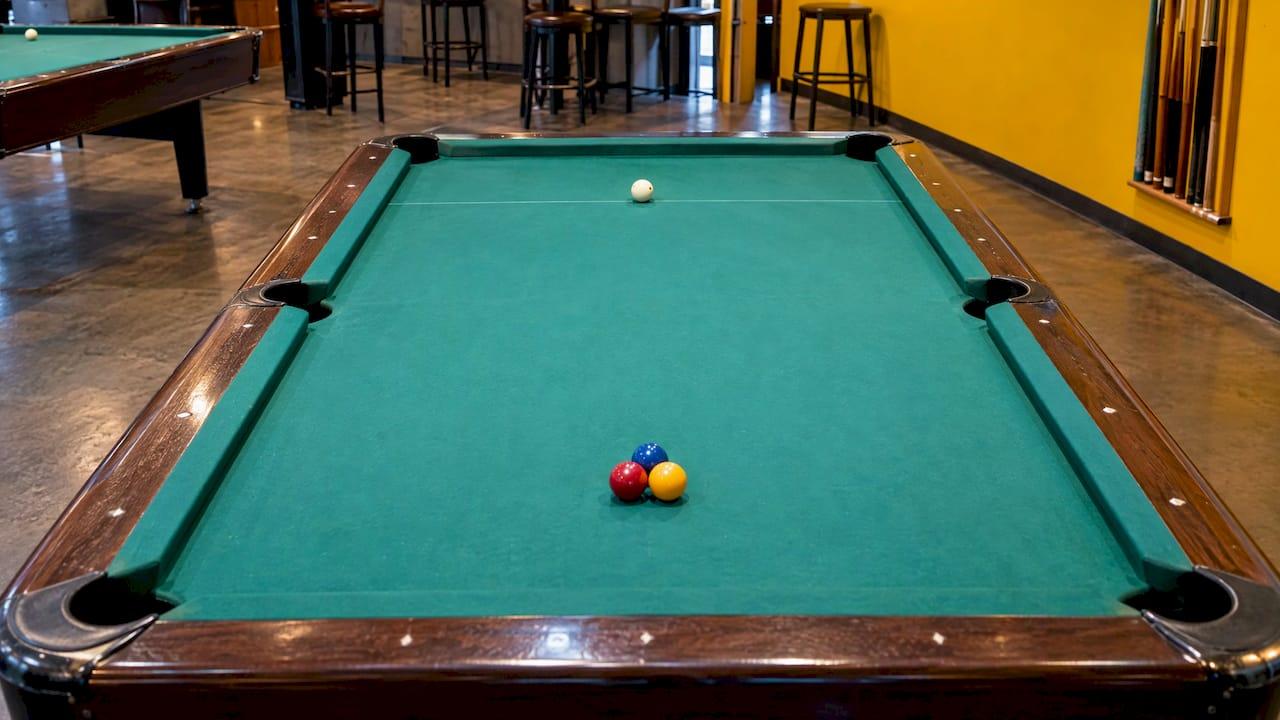
Three-ball is a quick pool game where you try to pocket three object balls in as few shots as possible, and the lowest score wins. You rack the balls in a tiny triangle, break, and keep shooting until all three are down. Every stroke of the cue ball costs one point, and every foul costs one more. There is no single official rulebook, so the details below are the most common version, plus the points you should settle at the table before the first break.
TL;DR
- Use a cue ball and any three object balls (usually the 1, 2 and 3). Rack them in a small triangle and break.
- Every shot counts as one point, including the break and misses. Each foul adds one more point.
- Keep shooting until all three balls are pocketed, you hit your agreed cutoff, or you concede. Then the next player gets a fresh rack.
- Lowest score wins. Ties usually go to a playoff round.
- Agree on the cutoff, scratch rules and tie-break before you start, because three-ball has no standardized rules.
Table of Contents
- What three-ball pool is
- What you need to play
- Setting up the rack
- Breaking in three-ball
- How to play a rack
- How scoring works
- Fouls and penalties
- Deciding the winner
- House rules to agree on before you start
- Practice: the 3-ball run-out drill
- Where to go from here
- Play 3-ball at Q Billiards Arena
- FAQ
- Sources
What three-ball pool is
Three-ball is a folk game played with a cue ball and any three standard pool object balls. The goal is simple: clear all three while shooting as little as possible. Think of it as golf on a pool table. A low number is good, and nobody cares which ball goes first.
It works well for a few reasons:
- A round takes a couple of minutes, so a group of any size can rotate through. The APA lists 3-Ball as a game that can accommodate any number of players in rotation.
- You do not need to be a strong player. A beginner and a league regular can play the same rack and both enjoy it.
- It is a good warm-up. A single rack tests your break, your cue ball control and your nerve in under a minute.
Three-ball is not three-cushion
The two names get mixed up all the time, and it explains why some search results about this keyword turn out to be about a different game. Three-cushion is a pocketless carom game in which the cue ball must hit both object balls after at least three cushion contacts. Three-ball is played on a regular pocket table and the goal is to sink balls. If you want to learn the carom game, our guide to carom billiards rules and drills covers it.

The same goes for the "three-foul rule" you may have heard about. That rule belongs to eight-ball and has nothing to do with this game. We explain it separately in the three-foul rule in pool.
What you need to play
- A pool table with pockets.
- One cue ball.
- Three object balls. A common setup uses the 1, 2 and 3, although no particular order is generally required.
- A small triangle rack, or just your hand.
- Something to keep score. A phone note or the table's chalk-free scoreboard is fine.
Two or more players is ideal. You can also play solo to practice, which is where the run-out drills on this page come in.
Setting up the rack
Place one object ball at the head of a triangle and the other two directly behind it. The common rack is a small triangle with the apex ball on the foot spot. Informal players often rack by hand, and one side of a nine-ball diamond can also make a straight-line rack if you do not have a mini triangle handy.
The cue ball goes on the head spot (or anywhere behind the head string, depending on the house rule you agreed) and you break from there. Racking is tight and neat, but nobody expects perfection. Just make sure the balls are touching and the apex sits on the foot spot.
Who racks?
Because each player breaks a fresh rack in turn, someone else racking for you is the fairest approach, though practice varies. Pick a convention at the start of the game and stick to it.
Breaking in three-ball
The break counts as a shot. In the common rules, no ball needs to touch a cushion on the break, unlike in most other pool games. Balls pocketed on the break are legal and stay down.
The break is the most important shot in the game, because it decides how many shots you will need afterward. Dr. Dave Alciatore's guide to breaking in 3-ball explains that a break can produce a score of one, two, three or four depending on what drops and how many shots follow. He also notes that the best break depends on your table and equipment.

Hard versus soft
There are two broad approaches:
- Soft, controlled break. You aim to scatter the balls gently and leave an easy first shot. Dr. Dave's guide describes this as one approach that can leave a manageable shot after the break.
- Power break. You try to pocket as many balls as possible right away. The same guide points out that going for all three on the break is a low-percentage play with more downside.
A classic soft-break recipe from the kitchen (the area behind the head string) is to send the cue ball off one rail and into the back two balls, aiming to send each toward a side pocket. It does not always work, but when it does you are left with a very easy run.
How to play a rack
- The first player racks, breaks, and keeps shooting.
- You stay at the table until all three object balls are pocketed, you reach the agreed maximum score, or you concede. The rules describe it this way: the breaker continues shooting until the three object balls are down or the cutoff is reached.
- Write down the total.
- The next player gets a fresh rack and starts over.
- After everyone has shot, the lowest score wins.
You do not have to call shots in the basic game. Any ball pocketed legally counts. If your group wants to make it harder, you can agree to call every shot, but you must decide that before play begins.
How scoring works
Scoring is the part players most often get wrong, so go slowly here.
- The break counts as one point.
- Each shot after the break counts as one point.
- A foul of any kind counts as an additional point added to your score.
- A shot counts the same whether it pockets no ball, one ball or several. A miss costs as much as a made ball.
So a three-stroke clearance beats a four-stroke clearance, and lower scores win.
One wrinkle: some sources say the break does not count as a shot. One summary of the game says the opening break does not count, though a miss does. Others, including the rule sets we cite above, count it. Since the break matters so much, agree on this first. We recommend counting the break, since that is how the most widely circulated rules treat it.
Worked examples
| Rack | What happened | Score |
|---|---|---|
| A | Break drops one ball, then two clean shots pocket the others | 3 |
| B | Break drops nothing, one miss, then three makes in a row | 5 |
| C | Break drops one ball, you scratch while pocketing the second, then one more shot finishes it | 1 (break) + 1 (second shot) + 1 (foul) + 1 (last shot) = 4 |
| D | Break drops two balls, one shot finishes the third | 2 |
| E | Break pockets all three | 1 |
The lone-shot clear in rack E is the dream. Most casual players land somewhere around three to five shots per rack, and strong players aim for two.
Fouls and penalties
A foul is any illegal action. The common ones:
- Scratch. The cue ball is pocketed or knocked off the table.
- Double hit. The cue tip touches the cue ball twice on one stroke.
- Push shot. The tip stays in contact with the cue ball too long.
- Illegally moving a ball with your hand, the butt of the cue or any other motion.
The usual penalty is one extra point per foul, and it applies even if the foul shot also pockets one or more object balls. So a scratch that also drops the 2-ball still costs you the stroke point and the foul point.
After a scratch
The common rule is that you do not get ball in hand anywhere on the table. Instead, you shoot the cue ball from on or behind the head string, and the shot must go forward across the head string. If an object ball gets knocked off the table, you spot it on the foot spot, and that is not a foul.
If you are used to eight-ball or nine-ball, this takes some getting used to. In those games a scratch usually hands your opponent ball in hand. Here the penalty is simply on your own scorecard.
Deciding the winner
After each player completes the agreed rack or round, the lowest score wins. For a longer session you can:
- Add up the scores across three or five racks per player.
- Award a point to whoever wins each round and play to a set number.
Ties
In a tie, a playoff is the usual answer. One published tournament rule set says that when any two players have the same score, another inning for the entire group is played. The group can instead agree that only the tied players repeat, as long as they agree before play starts. If another tie results, you repeat the playoff.
In gambling-style games you may also see a "one-tie-all-tie" variation, where every player moves on after a tie, usually with another ante, as described here.
House rules to agree on before you start
Because three-ball has no widespread official rules, local rule sets vary. A quick conversation before the first break saves arguments later. Settle these:
- Does the break count as a shot? (Most rule sets say yes.)
- Cutoff score. Cutoffs typically run from three to five points for experienced players and up to eight for less experienced ones. Once you reach it, your turn ends.
- Cue ball after a scratch. Behind the head string, or ball in hand?
- Called shots or not.
- Balls pocketed on a scratch. Do they stay down?
- Jump shots. Allowed or banned?
- Tie procedure. Whole-group playoff or tied players only?
- Who racks.
A stricter version
A Western Billiard Congress of America rules sheet describes a more restrictive gambling format. Three balls are racked in a triangle and players break from behind the head string. The breaking order rotates each round, and players must beat or tie a previous score. A score of five is the highest that can be posted, and play continues until only one player has the lowest number of strokes in a round.
If you are joining a pickup game you do not know, ask which version they play. It takes ten seconds.
Practice: the 3-ball run-out drill
Three-ball is also one of the best solo drills in pool. Toss the 1, 2 and 3 randomly onto the table, take the cue ball in hand and try to clear them in order of your choosing. If a ball drops while you are working, throw it back onto the table at random. The point is to learn to read patterns and to keep the cue ball under control. Count your shots as you go and try to beat your own average.
To build the habits that make this easier, work on:
- Position play. Think about where the cue ball will end up, not just whether the object ball goes in.
- Pattern recognition. Spot trouble balls (those near a rail or a cluster) and take care of them early.
- Break consistency. Hit the same spot on the cue ball at the same speed until the outcome is predictable.
For general table manners while you practice, our pool hall etiquette guide covers what to expect, and pool hall essentials lists what to bring.
Where to go from here
Once three-ball feels easy, there are games that reward the same skills over a longer run. Rotation pool asks you to hit the lowest ball every time. Straight pool rewards long runs with a break ball strategy. If you like the speed of three-ball, ten-ball and Chinese pool are good next steps.
Our take on three-ball
We see a lot of players at the table, and three-ball is one of the first games that gets a mixed group playing together. It is short, it is forgiving, and it makes newcomers feel like they belong. Because the rules are loose, we encourage everyone to say the rules out loud at the start. Two minutes of agreement beats twenty of arguing.
At Q Billiards Arena in Houston we have 25 professional-grade tables across an 11,000 square foot space, so there is room for a group to set up a quick three-ball rotation on one table while others play a full game on the next. We designed the club for exactly that mix of casual players, competitive players and people who just want good food and a good night out. Our late hours, which we run until 2 to 4 AM, suit the kind of players who start with a quick game and end up staying.
If you want to sharpen your game, the best thing is time on a well-kept table. Practice your break, track your average and challenge a friend to a best-of-five.
Q
Play 3-ball at Q Billiards Arena
Want to try these rules on a real table? At Q Billiards Arena in Houston, American pool is $10 per hour, which is plenty of room for a few rotations of three-ball with friends. Our menu has food, snacks and hot, cold and house special drinks, so you can stay at the table. We also run a promotion for free pool with an equal purchase.

If you want a more formal contest, check our pool tournament page for the weekly Tuesday and Friday night events, which have a $10 entry. Book a group night, order from our food and drink menu, and bring your own house rules.
FAQ
What does 3 ball mean in pool?
It refers to the folk game of three-ball, played with a cue ball and any three standard object balls. The goal is to pocket all three in as few shots as possible. In other contexts, "the 3 ball" can just mean the solid blue ball numbered three.
How do you win at three-ball?
You win by posting the lowest score. Each stroke, including the break and any miss, counts as one point, and each foul adds another. If two players tie, you play another round to break the tie.
Does the ball have to hit a rail on the break?
Not in the common rules. Unlike many other pool games, the usual three-ball rules do not require a ball to contact a rail on the break. Since local rules differ, confirm with your group first.
How many players can play three-ball?
As many as want to rotate through. The APA lists 3-Ball as a game that works for any number of players, since everyone takes a separate turn on a fresh rack.
Is three-ball the same as three-cushion billiards?
No. Three-ball is a pocket game, while three-cushion is a carom game played on a table without pockets, where the cue ball must contact three cushions before hitting the second object ball.
Sources
- Three-ball (Wikipedia)
- Basic Pool Terminology (APA)
- 3 Cushion Billiards (Basic Billiards)
- 3 Ball Rules (Billiards Forum)
- How to Break in 3-Ball (Dr. Dave)
- 3 Ball Pool Game Rules and Tournament Instructions
- 3 Ball Rules (Western Billiard Congress of America)
- 3 Ball Pool